
Water security in Ethiopia is deeply connected to the health of its watersheds, rivers, wetlands, groundwater systems, and catchments. In many places, safe water access does not begin at the tap or the borehole. It begins upstream, where landscapes, soils, forests, wetlands, and water sources determine the quantity and quality of water available to communities.
A new initiative in Ethiopia’s Tana Subbasin highlights this important connection. The World Resources Institute and partners have launched the Protecting Water Supplies and Catchments in Ethiopia’s Tana Subbasin project, known as ProTana. The project aims to strengthen water security in one of Ethiopia’s most important water-source areas.
The Tana Subbasin is part of the larger Abbay, or Blue Nile, River Basin. It supports more than 3 million people and plays a critical role in regional agriculture, industry, biodiversity, local livelihoods, and rural development.
The new five-year phase of the ProTana project builds on earlier work carried out since 2020 to promote sustainable water resources management, sound river-basin administration, and watershed protection in the region.
The project focuses on three woredas of the Amhara Region that overlap the Tana Subbasin: North Mecha, Farta, and Dera. These areas are important because they represent both hydrological and administrative landscapes where water governance, watershed management, community action, and local development must work together.
The initiative uses a “source-to-system” approach. This means that water security is not treated only as an infrastructure issue. Instead, the project connects water resources management, water, sanitation and hygiene, climate resilience, catchment protection, and community-based watershed restoration.
This approach is highly relevant for Africa. Many water projects fail or become less reliable when the source waters are degraded. Deforestation, land degradation, soil erosion, poor catchment management, and climate variability can reduce groundwater recharge, increase sedimentation, affect water quality, reduce baseflow, and increase vulnerability to droughts and floods.
The Tana Subbasin faces these same pressures. Water levels and water quality are threatened by deforestation, land degradation, biodiversity loss, climate variability, increasing water demand, and governance gaps across different institutions and administrative levels.
For this reason, the ProTana project aims to address both natural and institutional challenges. It seeks to strengthen data-driven decision-making, improve integrated governance, support community-based watershed management, and protect water sources before water services become unreliable.
One of the most important parts of the initiative is community-led watershed restoration. ProTana aims to restore approximately 2,000 hectares of severely degraded micro-watersheds. This can help improve hydrological function, support groundwater recharge, reduce erosion, protect source waters, and strengthen local livelihoods.
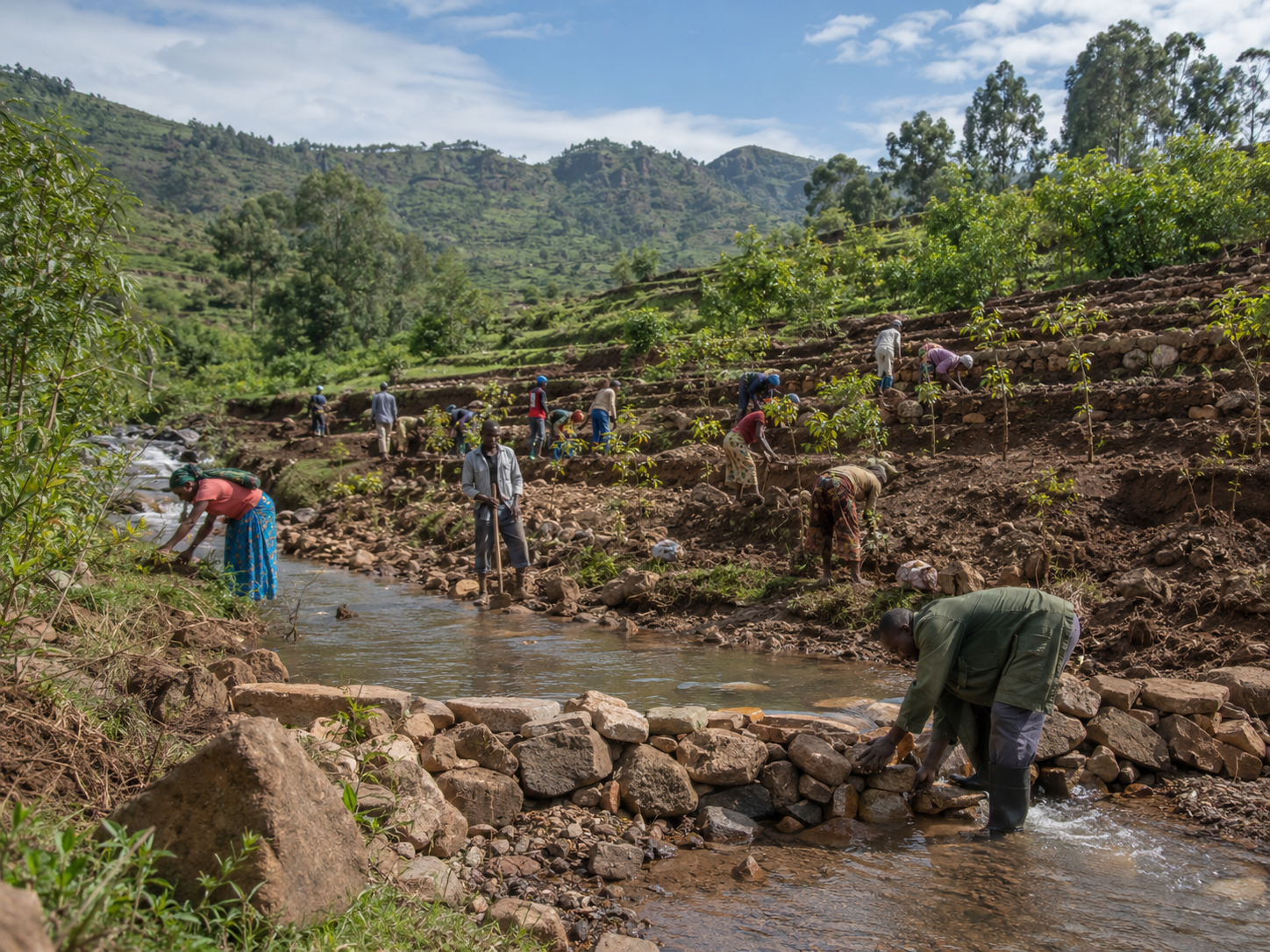
The project also aims to improve decision-making at woreda, regional, and basin levels. This is important because water does not follow administrative boundaries. Effective water management requires cooperation between water, agriculture, environment, forestry, land administration, energy, local government, communities, and basin institutions.
For African water professionals, Ethiopia’s ProTana initiative is highly relevant. It shows that future water security will require integrated approaches that connect engineering, hydrology, watershed management, governance, WASH, climate resilience, and community participation.
Opportunity Watch:
- Integrated Water Resources Management
- Catchment protection
- Watershed restoration
- Micro-watershed rehabilitation
- Water-source protection
- Groundwater recharge improvement
- Soil and water conservation
- Lake Tana and Abbay Basin water governance
- WASH and climate resilience
- Water-quality protection
- Hydrological monitoring
- Data-driven water planning
- Community-based watershed management
- Institutional capacity building
- River-basin administration
- Climate-risk assessment
- Drought and flood resilience
- Nature-based solutions for water security
- Local livelihood support
- Monitoring and evaluation
This project should be followed closely by hydrologists, hydrogeologists, water resources engineers, watershed specialists, WASH professionals, environmental scientists, catchment managers, soil and water conservation experts, local government planners, NGOs, consultants, researchers, students, and community-development professionals.
For AquaLinked / Water for Africa Experts, Ethiopia’s Tana Subbasin initiative is an important story because it shows that African water security must begin at the source. Pipes, pumps, treatment plants, reservoirs, and boreholes are important, but they cannot remain reliable if the watersheds that feed them are degraded.
The ProTana project also sends a wider message for Africa. Climate-resilient water security requires healthy landscapes, strong institutions, informed communities, reliable data, and professionals who understand the full water system from source to service.
Ethiopia’s Tana Subbasin is therefore not only a local water story. It is a continental lesson in how catchment protection, governance, WASH, and climate resilience can come together to protect water supplies and support communities for the long term.
Sources
Official references used for this article.
Comments
Comments are reviewed by AquaLinked Media before public display. If your email matches an approved AquaLinked expert profile, your comment may appear with your expert profile link after approval.
No approved comments yet. Be the first to contribute respectfully.
No password is needed. Enter the email connected to your expert profile, and the system will check whether your expert profile exists.
Please login or register before commenting.