
Kandadji Irrigation and Water Security Program: Niger’s Strategic Niger River Development Project
The Kandadji Irrigation and Water Security Program is one of Niger’s most important water-resource development initiatives. Located on the Niger River in the Tillabéri Region, northwest of Niamey, the program is designed as a multipurpose development project combining irrigation expansion, river-flow regulation, hydropower generation, improved dry-season water availability, ecosystem regeneration, and rural livelihood development.
Kandadji is especially important because Niger is a Sahelian country where drought, rainfall variability, food insecurity, and limited electricity access strongly affect rural life and national development. In this context, the Kandadji Program is not only a dam project. It is a national water-security and agricultural-resilience platform built around the controlled use of the Niger River.
The project is part of the wider Niger Basin Water Resources Development and Sustainable Ecosystems Management Program. Its purpose is to improve water availability for agriculture, strengthen energy generation capacity, support livelihoods in the Tillabéri Region, and improve the management of Niger’s section of the Niger Basin.
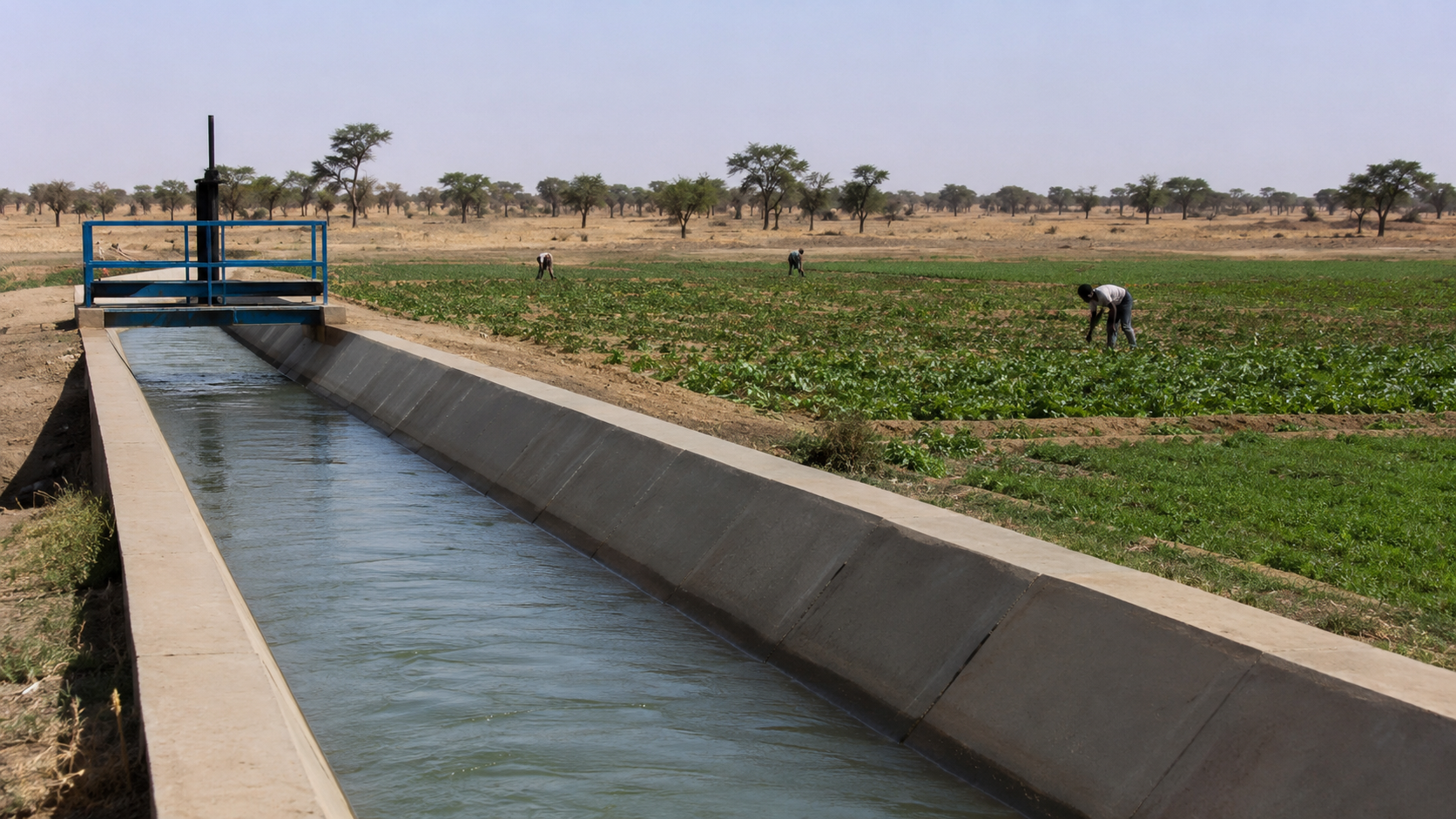
A wide view of the Kandadji project would show the Niger River landscape, the dam and reservoir area, planned irrigated lands, nearby communities, and the wider Sahelian environment where water regulation can support food production, electricity, livelihoods, and ecosystem protection.
Project Fact Box
- Project: Kandadji Irrigation and Water Security Program
- Official program name: Kandadji Program for Ecosystem Regeneration and Niger Valley Development / Programme Kandadji de Régénération des Écosystèmes et de Mise en Valeur de la Vallée du Niger
- Country: Niger
- Region: Tillabéri Region, western Niger
- Main river: Niger River
- Approximate location: Northwest of Niamey, commonly described around 180–190 km from the capital
- Project type: Multipurpose dam, reservoir, irrigation development, hydropower, water security, river regulation, ecosystem regeneration, and livelihood support
- Main purpose: Increase water availability for agriculture, improve dry-season river regulation, support irrigation, generate hydropower, strengthen food security, improve livelihoods, and support Niger River basin management
- Irrigation objective: Up to about 45,000 hectares of irrigated land
- Hydropower component: Commonly reported as about 130 MW planned installed capacity
- Expected electricity generation: Some project descriptions report about 629 GWh per year when fully operational
- Main water-security role: Regulation of Niger River flows, especially during dry periods, to support agriculture, communities, ecosystem needs, and downstream water availability
- Drinking-water relevance: Linked to improved water availability and security for communities, including the broader Niamey water-supply context
- Institutional context: Government of Niger, Kandadji Dam Agency / national implementing bodies, Niger Basin Authority, World Bank, African Development Bank, and other development partners
Strategic value: Sahel food security, irrigation expansion, renewable energy, river-basin regulation, climate resilience, ecosystem regeneration, and rural economic development
A Sahelian Water-Security Project Built Around the Niger River
The Kandadji Program depends on the Niger River, one of West Africa’s most important rivers. In Niger, the river is not only a natural watercourse; it is a lifeline for agriculture, fishing, livestock, domestic water supply, local economies, and ecosystems.
The project is designed to store and regulate water so that river flow can be better managed, especially during the dry season. This is important because Sahelian countries face strong seasonal contrasts. During the rainy season, floods may occur, while in the dry season water scarcity can become severe. Kandadji aims to reduce this vulnerability by creating a more reliable water-management structure.
Unlike a purely irrigation canal project, Kandadji is a multipurpose infrastructure program. Its benefits are expected to come from the combination of reservoir storage, regulated river flow, irrigation development, hydropower production, ecosystem support, and improved local livelihoods.
For Niger, this makes Kandadji a strategic national project. It connects water engineering with food security, electricity supply, climate adaptation, and regional development.
Salient Points of the Project
The first salient point is water security. Kandadji is designed to improve the availability and management of Niger River water in a country where drought and climate variability create serious risks for agriculture and livelihoods.
The second salient point is irrigation development. The program is expected to support irrigation of up to about 45,000 hectares of land. This is one of the most important agricultural objectives of the project because irrigated farming can reduce dependence on unreliable rainfall and support dry-season production.
The third salient point is food security. By supporting irrigated agriculture, Kandadji can help increase local food production, stabilize farming systems, improve rural income, and reduce the vulnerability of communities exposed to drought and crop failure.
The fourth salient point is river regulation. The dam and reservoir are intended to regulate Niger River flows, especially during dry periods. This can support agriculture, domestic water needs, ecosystems, and downstream river management.
The fifth salient point is hydropower. Kandadji includes a hydropower component commonly reported at about 130 MW. This is important because Niger has long faced electricity-supply constraints, and hydropower can support national energy security and economic development.
The sixth salient point is ecosystem regeneration. The program is not only about water extraction. It is officially linked to ecosystem regeneration and Niger Valley development, showing that environmental flows, river health, and local livelihoods are part of the wider planning framework.
The seventh salient point is regional river-basin importance. Kandadji is part of the Niger Basin system. Its operation matters not only locally but also in relation to broader river-basin planning, downstream users, and regional water cooperation.
The eighth salient point is social responsibility. Large multipurpose dams can require resettlement, livelihood restoration, compensation, and social safeguards. Kandadji therefore carries important lessons about how infrastructure must be implemented with fairness, transparency, and long-term support for affected communities.
The ninth salient point is climate resilience. In the Sahel, water storage and controlled irrigation are central to adaptation. Kandadji represents an attempt to build resilience against rainfall uncertainty, drought, food insecurity, and energy shortage.
The tenth salient point is implementation complexity. Kandadji has involved many phases, development partners, financing arrangements, and institutional responsibilities. This shows that major irrigation and water-security projects require not only engineering design but also strong governance, financing discipline, environmental management, and social trust.
Engineering and Water-Management Ability
The engineering logic of Kandadji is based on river regulation. By creating a dam and reservoir on the Niger River, the project aims to store water and make it available when natural river flow becomes insufficient.
This regulated water can support irrigation development downstream and in planned agricultural areas. For irrigation engineers, the project is important because it links reservoir operation with command-area development, water delivery, crop-water demand, river-flow management, and downstream water security.
The Kandadji system is therefore different from a small local irrigation scheme. It is a basin-scale water-management project. Its operation must consider reservoir levels, inflow variability, flood control, environmental flows, hydropower generation, irrigation demand, and downstream river needs.
The irrigation component is expected to support controlled agricultural development. This requires more than simply storing water. It also requires canals, distribution systems, field development, drainage, farmer organization, operation rules, maintenance systems, and institutional coordination.
The hydropower component adds another layer of complexity. Reservoir operation must balance energy generation with irrigation requirements, dry-season river-flow support, ecosystem needs, and social obligations. This makes Kandadji a major case study in multipurpose water-resource operation.
Irrigation Area and Agricultural Command
One of the most important figures associated with Kandadji is the planned irrigation of up to about 45,000 hectares. This figure is significant for Niger because irrigated agriculture is essential in a country where rain-fed agriculture is vulnerable to climate shocks.
The irrigation development linked to Kandadji is intended to support agricultural production, improve food security, and create more stable livelihoods. In Sahelian conditions, irrigation can make a major difference because it allows farmers to produce during dry periods and reduce dependence on uncertain seasonal rainfall.
However, the practical success of the irrigation component depends on implementation quality. Irrigated land must be properly developed, water delivery must be reliable, drainage must be managed, and farmers must receive fair access to land and water.
A large irrigation target does not automatically become successful agriculture. The land must be prepared, canals must function, water must be allocated transparently, and farmers must be supported with inputs, training, market access, and maintenance systems.
This is why Kandadji should be understood as both an engineering project and an agricultural-development program. The dam can provide water, but agricultural success depends on how that water is delivered, governed, and used.
Project Cost and Investment Note
Kandadji has been supported by several development partners over time, including the World Bank and the African Development Bank. World Bank project information identifies the Kandadji operation as part of the Niger Basin Water Resources Development and Sustainable Ecosystems Management Program, while African Development Bank materials describe support for the Kandadji Ecosystems Regeneration and Niger Valley Development Program.
A useful financing reference is the African Development Bank financing agreement reported in 2019, which described about US$128.8 million in support for the Kandadji project. World Bank support has also included major financing for water and energy infrastructure connected to the program.
The full cost of Kandadji should be treated carefully because the program has evolved through phases, restructuring, co-financing, dam construction, hydropower equipment, irrigation development, resettlement, environmental safeguards, and institutional support. It is better to describe Kandadji as a multi-phase, multi-partner investment rather than as a single simple construction contract.
Agricultural and Economic Importance
Kandadji is important for agriculture because Niger needs reliable water to strengthen food production. In a drought-prone Sahelian country, irrigation can help stabilize agricultural output and support rural communities.
The program can also support job creation. Irrigation development creates work not only for farmers but also for canal operators, maintenance teams, traders, transporters, processors, input suppliers, and service providers. When water is reliably available, rural economies can become more active and less dependent on emergency responses to drought.
Hydropower also contributes to economic development. Electricity can support local services, agro-processing, pumping, communication, refrigeration, small industries, schools, health centers, and urban supply systems.
Kandadji therefore connects agriculture, water, energy, and livelihoods. Its value is not limited to one sector. Its success depends on coordinated development across several sectors.
Land, Water, and Governance Challenges
Like all large multipurpose water projects, Kandadji faces governance challenges. These include land allocation, resettlement, compensation, livelihood restoration, water rights, maintenance responsibility, environmental flows, and the balance between national development and local community protection.
Resettlement is one of the most sensitive parts of large dam development. Communities affected by the reservoir or project works must not only be moved physically; they must also receive sustainable livelihood restoration, access to services, agricultural land, compensation, and long-term support.
Water governance is also essential. The Niger River serves many users and ecosystems. Kandadji must therefore be operated within a wider basin-management framework that considers upstream and downstream needs.
The success of Kandadji will depend on the strength of institutions. Engineering can build a dam, but institutions must manage water allocation, maintenance, farmer support, environmental protection, and social accountability.
Environmental and River-Basin Importance
Kandadji is part of the Niger River Basin, and this gives it environmental importance beyond the project site. River regulation can support dry-season flows, but it can also change natural flow patterns. For this reason, environmental management must be part of reservoir operation.
The project’s official connection to ecosystem regeneration is important. It suggests that the program recognizes the need to protect river systems, wetlands, fisheries, vegetation, and downstream livelihoods.
The Niger River supports communities, agriculture, livestock, fisheries, ecosystems, and urban water needs. Any major regulation project must therefore be managed with basin-scale awareness.
Environmental sustainability will depend on maintaining appropriate flows, managing sediment and water quality, protecting affected communities, and monitoring impacts over time.
Current Challenges and Modernization Needs
Kandadji’s future success depends on completing infrastructure, developing the irrigation command areas, strengthening institutions, and ensuring that affected communities benefit from the project.
Modernization tools can help. Remote sensing can monitor irrigated land development and crop performance. Hydrological modelling can guide reservoir operation. Digital water accounting can support allocation decisions. GIS can help manage land, canals, villages, and service areas. Monitoring systems can track social and environmental commitments.
For irrigation development, modern success will require strong field-level planning. This includes land levelling, canal design, drainage, water scheduling, farmer participation, maintenance financing, and transparent land governance.
Kandadji should not be judged only by the dam structure. It should be judged by whether it improves water security, food production, livelihoods, energy access, and environmental management over the long term.
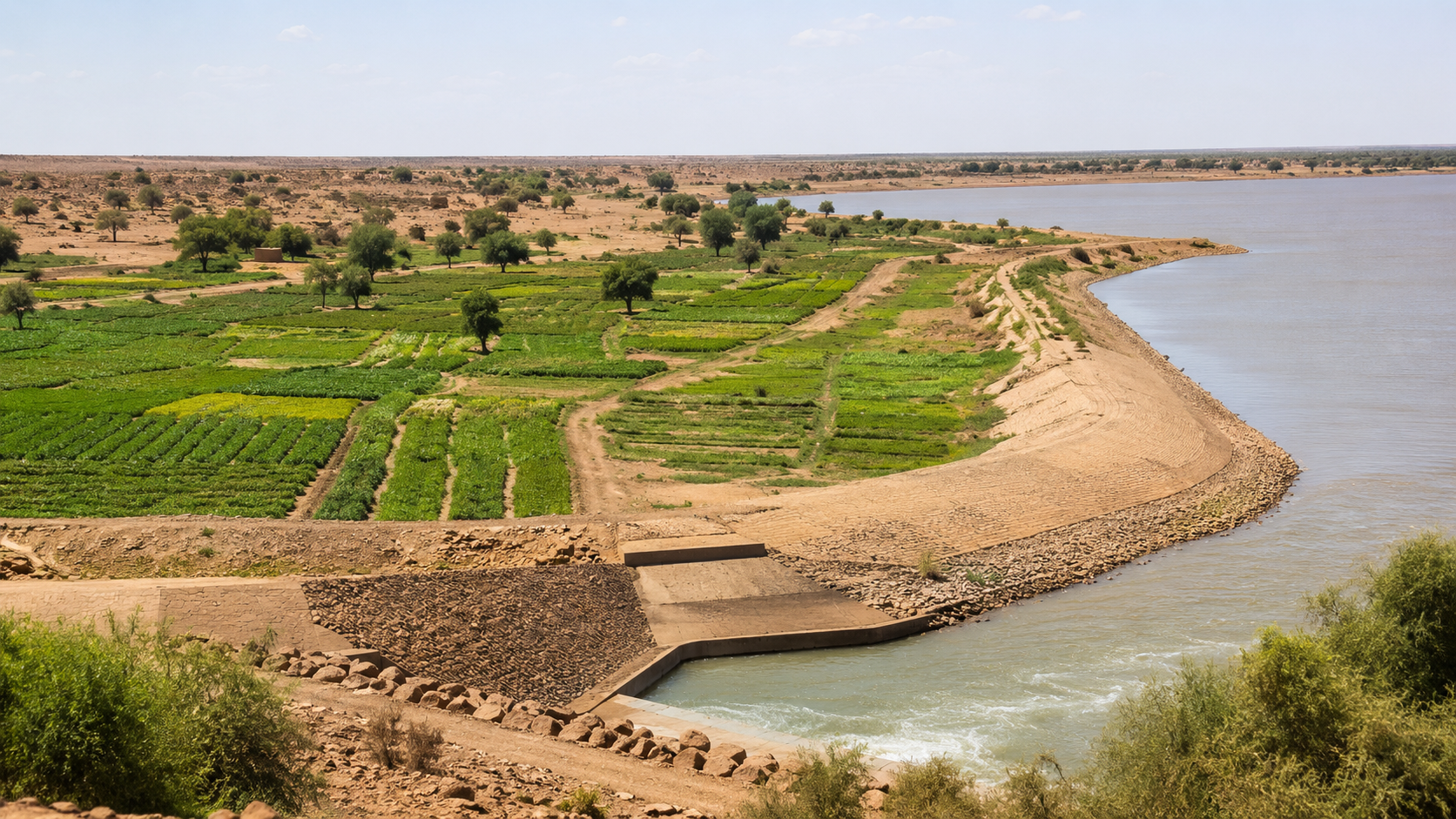
Why Kandadji Is Important
Kandadji is important because it represents one of the Sahel’s major attempts to transform river water into long-term development. It is a project about water control, food security, electricity, climate resilience, and rural opportunity.
For engineers and hydrologists, Kandadji is a case study in multipurpose dam planning, reservoir regulation, irrigation command development, hydropower integration, and basin-scale water management.
For agricultural planners, it is an example of how irrigation can support dry-season production and reduce vulnerability to rainfall variability.
For policymakers, it is a reminder that major infrastructure must be combined with social safeguards, environmental responsibility, strong institutions, and transparent governance.
For Niger, Kandadji is a strategic national project. It has the potential to support agriculture, energy, water security, and rural livelihoods in one of the world’s most climate-vulnerable regions.
For AquaLinked / Water for Africa Experts Media, Kandadji deserves a central place in the series “Major Irrigation Projects in Africa.” It is not only a dam on the Niger River. It is a Sahelian water-security program that shows how irrigation, hydropower, ecosystem regeneration, and national resilience can be connected in one major African development project.
Kandadji is therefore more than an infrastructure project. It is a test of how Africa can use its great rivers wisely—building water security, supporting farmers, protecting ecosystems, and creating long-term development in dryland regions.
Sources
Official references used for this article.
Comments
Comments are reviewed by AquaLinked Media before public display. If your email matches an approved AquaLinked expert profile, your comment may appear with your expert profile link after approval.
No approved comments yet. Be the first to contribute respectfully.
No password is needed. Enter the email connected to your expert profile, and the system will check whether your expert profile exists.
Please login or register before commenting.