
Nachtigal Hydropower Project: Cameroon’s Sanaga River Powerhouse for National Electricity Supply
The Sanaga River is Cameroon’s most important hydropower river. It carries the country’s largest hydroelectric potential and has long been central to national electricity planning, industrial development, and renewable energy generation.
This is why the Nachtigal Hydropower Project deserves a place among Africa’s major water and energy projects. Located on the Sanaga River, about 65 kilometres northeast of Yaoundé, Nachtigal is one of Cameroon’s most important renewable energy investments and one of the most significant public-private hydropower projects in Africa.
The project has an installed capacity of 420 MW and is designed to strengthen Cameroon’s national electricity supply. EDF Cameroon describes Nachtigal as the most powerful hydroelectric plant in the country, commissioned in March 2025, and able to cover nearly 30 percent of Cameroon’s energy needs with clean, available, and lower-cost electricity.
For Cameroon, Nachtigal is not only a dam and power station. It is a national energy-security project. It is intended to reduce power shortages, support households, strengthen industries, improve grid reliability, and reduce the need for more expensive thermal power generation.
Nachtigal Hydropower Project on the Sanaga River, showing the dam, powerhouse, river-control structures, and renewable energy infrastructure designed to strengthen Cameroon’s national electricity supply.
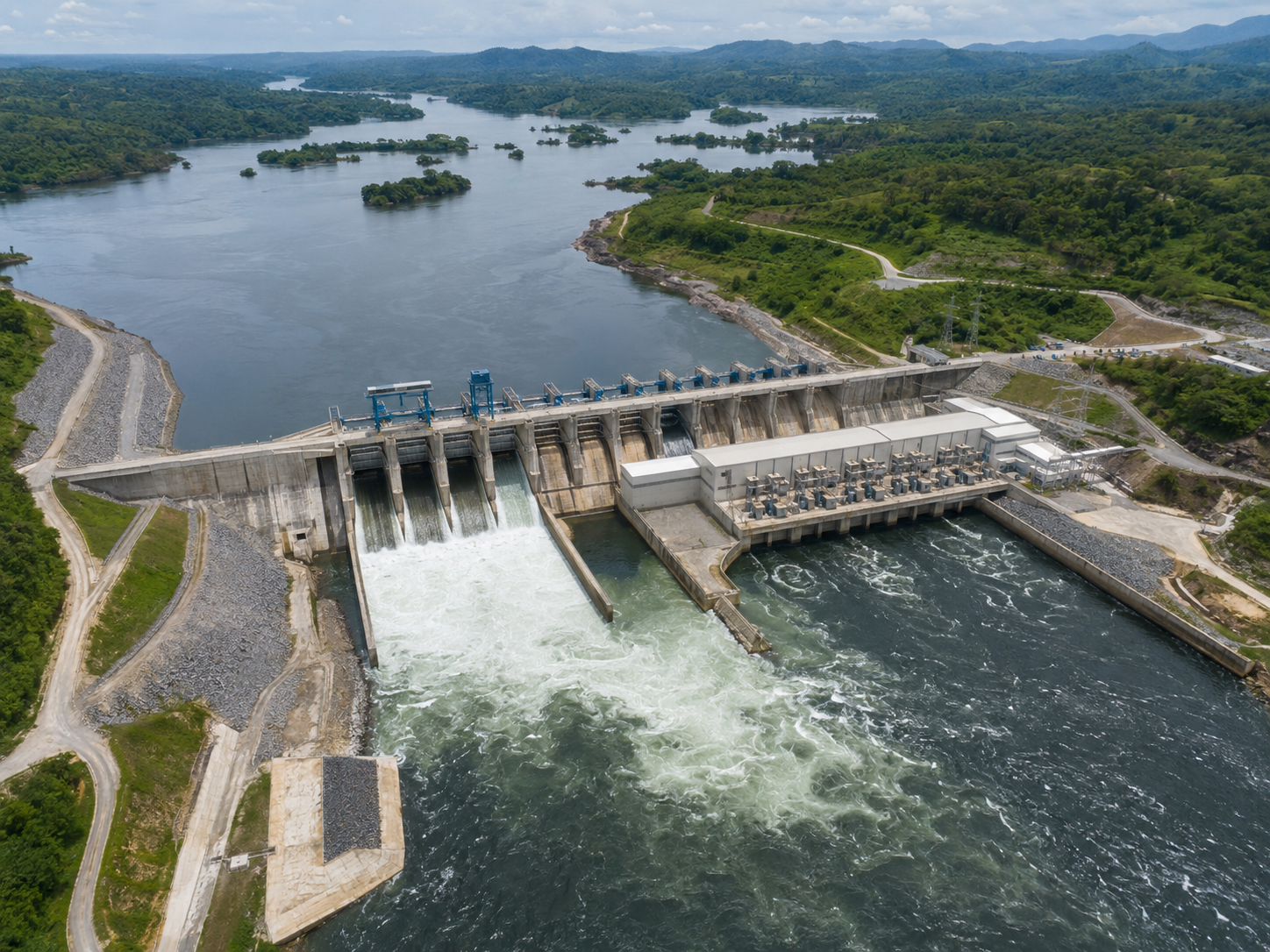
Nachtigal Hydropower Project on the Sanaga River, showing the dam, powerhouse, river-control structures, and renewable energy infrastructure designed to strengthen Cameroon’s national electricity supply.
Project Snapshot
- Project: Nachtigal Hydropower Project / Nachtigal Amont Hydropower Project
- Country: Cameroon
- River: Sanaga River
- Location: Near Nachtigal Falls, about 65 km northeast of Yaoundé
- Installed capacity: 420 MW
- Project type: Run-of-river hydropower project
- Turbines: 7 Francis turbines of about 60 MW each
- Main infrastructure: Dam, hydropower plant, headrace canal, powerhouse, substation, and transmission line
- Transmission connection: About 50 km transmission line to connect the project to the national grid
- Project company: Nachtigal Hydro Power Company
- Main purpose: Renewable electricity generation and national grid supply
- Strategic value: National electricity security, industrial power supply, renewable energy development, grid reliability, and reduced dependence on thermal generation
- Current status: Commissioned / operational, with first power injected in 2024 and full commissioning reported in 2025
The importance of Nachtigal begins with Cameroon’s electricity needs. Reliable power is essential for households, schools, hospitals, water systems, public services, industry, digital services, and economic growth. When electricity supply is weak, development becomes slower and more expensive. A 420 MW hydropower project can therefore make a major national contribution.
Nachtigal is especially important because it is connected to the Southern Interconnected Grid, which serves a large share of Cameroon’s electricity demand. By adding significant renewable generation to this grid, the project can help reduce supply pressure, improve reliability, and support the energy needs of population centres and industries.
The project is also important because it uses the hydropower potential of the Sanaga River. The Sanaga has already supported major hydropower development in Cameroon, including earlier projects such as Edéa and Song Loulou. Nachtigal adds a new generation asset to this river system and strengthens the country’s long-term renewable energy base.
One of the defining characteristics of Nachtigal is that it is a run-of-river hydropower project. This means the project is designed to generate electricity mainly from river flow, with less dependence on a very large seasonal storage reservoir compared with some large storage dams. Run-of-river projects can have smaller reservoir footprints, but they still require careful river management, hydraulic design, environmental safeguards, sediment monitoring, and flow regulation.
The technical layout of Nachtigal includes a dam, power-generation facilities, hydraulic conveyance works, and transmission infrastructure. Project documents describe a 420 MW plant with seven 60 MW turbines, a headrace canal, a powerhouse, and a transmission line of about 50 kilometres to connect the electricity to the national network.
Detailed view of the Nachtigal hydropower infrastructure, showing the dam and powerhouse system designed to convert the Sanaga River’s flow into renewable electricity for Cameroon.
Detailed view of the Nachtigal hydropower infrastructure, showing the dam and powerhouse system designed to convert the Sanaga River’s flow into renewable electricity for Cameroon.
Nachtigal also stands out because of its financing and project structure. It is often described as one of Africa’s largest public-private energy partnerships. The project brought together the Government of Cameroon, international development finance institutions, private investors, and technical partners. This kind of structure shows how major infrastructure can be delivered through blended financing, long-term power purchase agreements, and institutional cooperation.
For African energy planning, this is an important lesson. Many countries need major infrastructure, but public budgets alone are often not enough. Public-private partnerships can help mobilize capital, technical capacity, and long-term operational responsibility. At the same time, they require strong regulation, transparent contracts, fair tariffs, environmental compliance, and public accountability.
The environmental and social dimension of Nachtigal is also important. Hydropower projects on major rivers affect water flow, aquatic habitats, fisheries, riverbanks, local livelihoods, construction zones, land use, and downstream users. Even run-of-river projects require careful environmental and social management because the river is not only a source of electricity. It is also a living ecosystem and a resource for communities.
For this reason, Nachtigal must be understood as both an energy project and a river-management project. Its long-term value depends not only on megawatts produced, but also on how well environmental flows, sediment, aquatic biodiversity, water quality, local livelihoods, safety, and community relations are managed.
The project also has national climate significance. Hydropower can provide renewable electricity and reduce reliance on fossil-fuel-based thermal generation. For Cameroon, this means Nachtigal can contribute to lower-carbon electricity supply while supporting economic development. In a period when African countries need both development and climate resilience, this combination is strategically important.
However, hydropower is not automatically risk-free. River flows can change under climate variability. Drought periods can reduce generation, while floods can create operational and safety challenges. A project such as Nachtigal therefore requires strong hydrological monitoring, dam safety management, climate-risk planning, maintenance discipline, and long-term basin-level coordination.
For engineers, Nachtigal is a valuable case study. It brings together hydrology, hydraulic engineering, dam design, turbine operation, river diversion, canal design, electromechanical systems, transmission planning, environmental management, and public-private project financing.
For water resources professionals, it raises questions about river-basin management, environmental flows, sediment, water quality, downstream impacts, and coordination between energy generation and river health. For policy-makers, it raises questions about national energy security, tariff sustainability, private investment, development finance, and long-term governance.
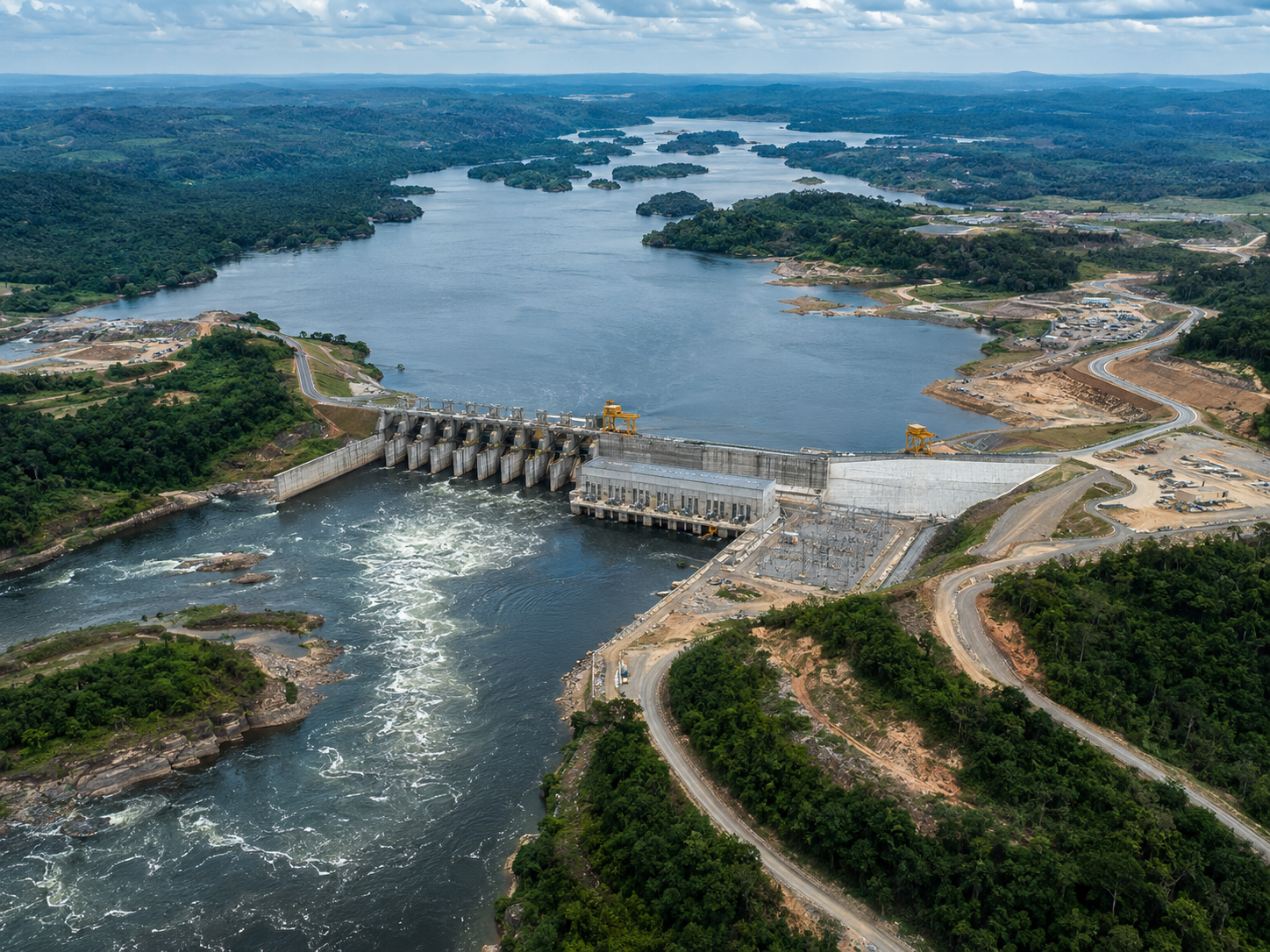
Aerial view of the Sanaga River corridor and Nachtigal project zone, showing the relationship between river flow, hydropower infrastructure, transmission planning, and Cameroon’s national energy system.
Aerial view of the Sanaga River corridor and Nachtigal project zone, showing the relationship between river flow, hydropower infrastructure, transmission planning, and Cameroon’s national energy system.
The current status of Nachtigal is especially important because it is no longer only a future promise. EDF Cameroon reports that Nachtigal was commissioned in March 2025. Earlier project updates also reported that the first power was injected into the grid in 2024. This means the project has moved from construction into operation, making it a real contribution to Cameroon’s power supply rather than only a planned investment.
This makes Nachtigal different from many African megaprojects that remain delayed for many years. It shows that major hydropower infrastructure can move from planning to financing, construction, commissioning, and national grid contribution when institutions, financing, engineering, and implementation are coordinated.
Still, the project should be followed over time. The real success of a hydropower project is measured not only at commissioning, but during decades of operation. Long-term performance depends on turbine reliability, reservoir and river management, maintenance, transmission stability, environmental compliance, community relations, and financial sustainability.
For Cameroon, Nachtigal could become one of the backbone projects of the national electricity system. It can support industrial development, improve electricity availability, reduce supply deficits, and strengthen renewable energy generation. For Africa, it shows how a well-financed hydropower project can contribute to national development when supported by strong technical and institutional arrangements.
For AquaLinked / Water for Africa Experts Media, Nachtigal is an essential story because it represents a completed or commissioned major African hydropower project, not only a planned one. It shows the practical link between water resources, renewable energy, public-private financing, engineering execution, and national development.
Nachtigal is therefore more than a 420 MW power station. It is a strategic Sanaga River infrastructure project, a renewable energy asset, and a national electricity-security investment for Cameroon.
Its final value will be measured not only in megawatts, but in reliable electricity delivered, industries supported, homes powered, thermal generation reduced, environmental responsibilities respected, and Cameroon’s ability to use its river resources wisely for long-term development.
Sources
Official references used for this article.
Comments
Comments are reviewed by AquaLinked Media before public display. If your email matches an approved AquaLinked expert profile, your comment may appear with your expert profile link after approval.
No approved comments yet. Be the first to contribute respectfully.
No password is needed. Enter the email connected to your expert profile, and the system will check whether your expert profile exists.
Please login or register before commenting.