Drip Irrigation Systems — Precision Water Delivery for Climate-Resilient Agriculture
Drip irrigation systems are precision water-delivery technologies that apply water slowly and directly to the crop root zone through emitters, lateral pipes, filters, valves, and pressure-control devices. They are especially important for water-saving agriculture, vegetable production, orchards, greenhouses, fertigation, solar-powered irrigation, and climate-resilient farming. For Africa, drip irrigation can help farmers produce more food with limited water, reduce dependence on unreliable rainfall, and move toward smarter, more efficient agricultural water management. However, success depends on correct design, good filtration, stable pressure, water-quality assessment, farmer training, regular flushing, and long-term maintenance.
Author: AquaLinked Media Editorial TeamMay 29, 2026
Drip Irrigation Systems — Precision Water Delivery for Climate-Resilient Agriculture
Drip irrigation systems are among the most important modern technologies for agricultural water management. They are designed to deliver water slowly, carefully, and directly to the crop root zone through emitters, drippers, laterals, filters, valves, and pressure-control devices. Unlike traditional flood irrigation, where water spreads over the field surface, drip irrigation applies water only where the crop needs it most.
This technology is especially important in areas where water is limited, rainfall is unreliable, pumping energy is costly, or farmers need to produce more food with less water. In Africa, drip irrigation can support vegetable production, fruit orchards, greenhouse farming, smallholder gardens, commercial farms, dryland agriculture, and climate-resilient food production.
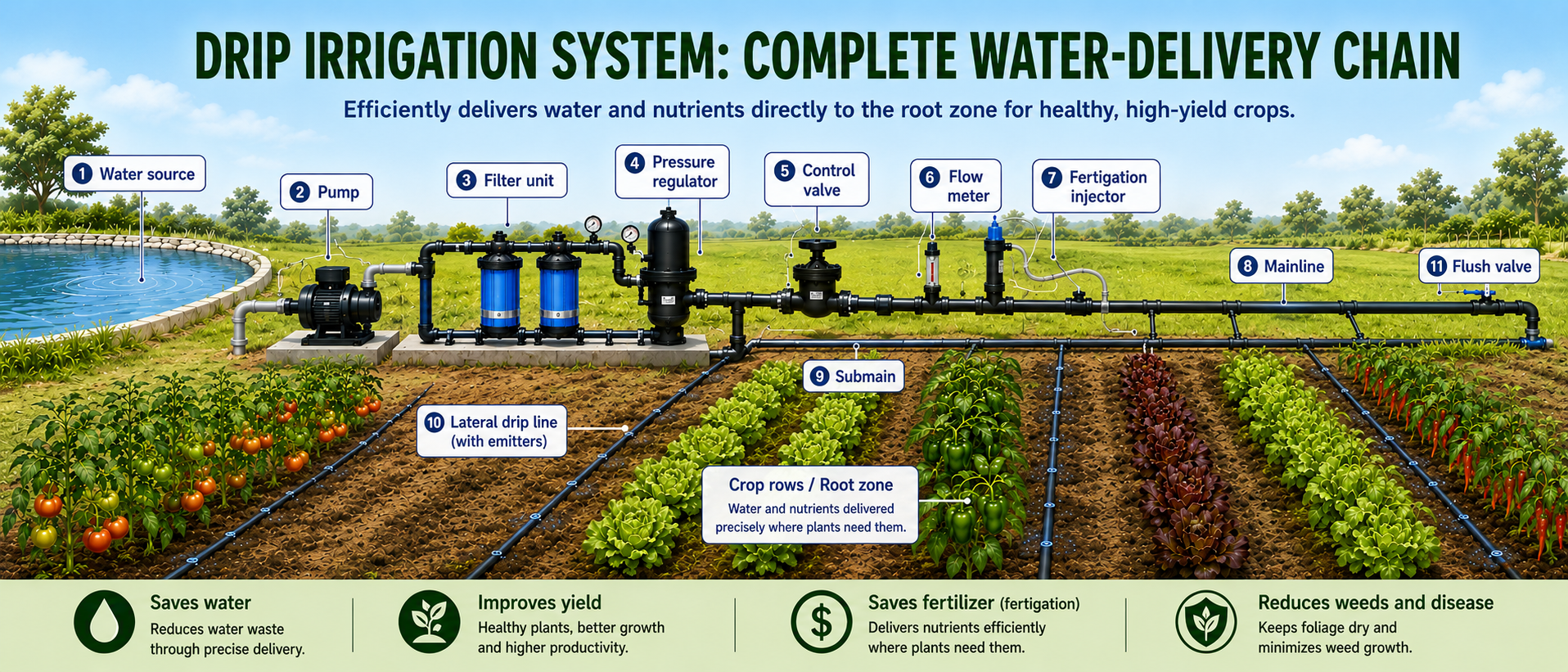
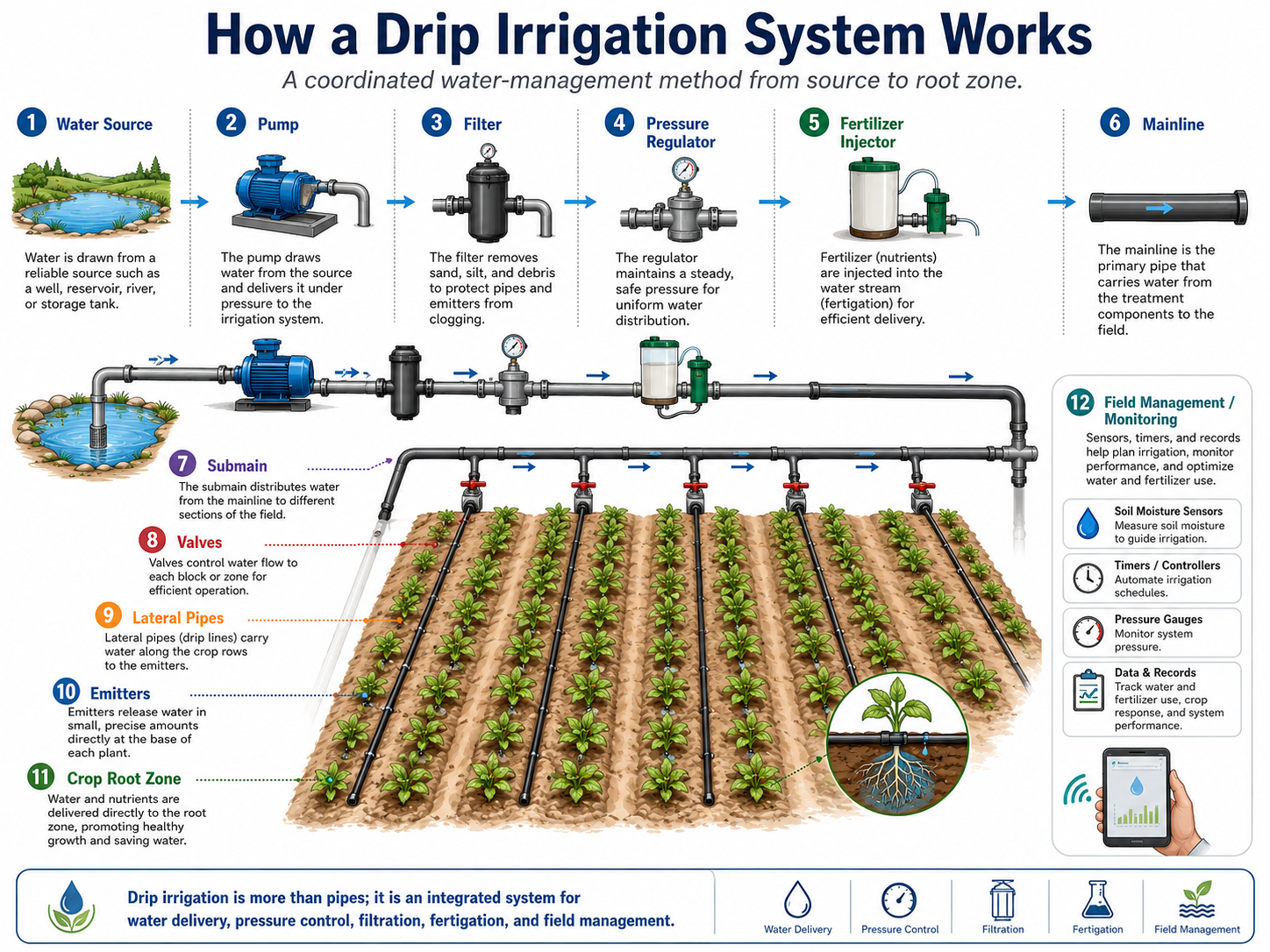
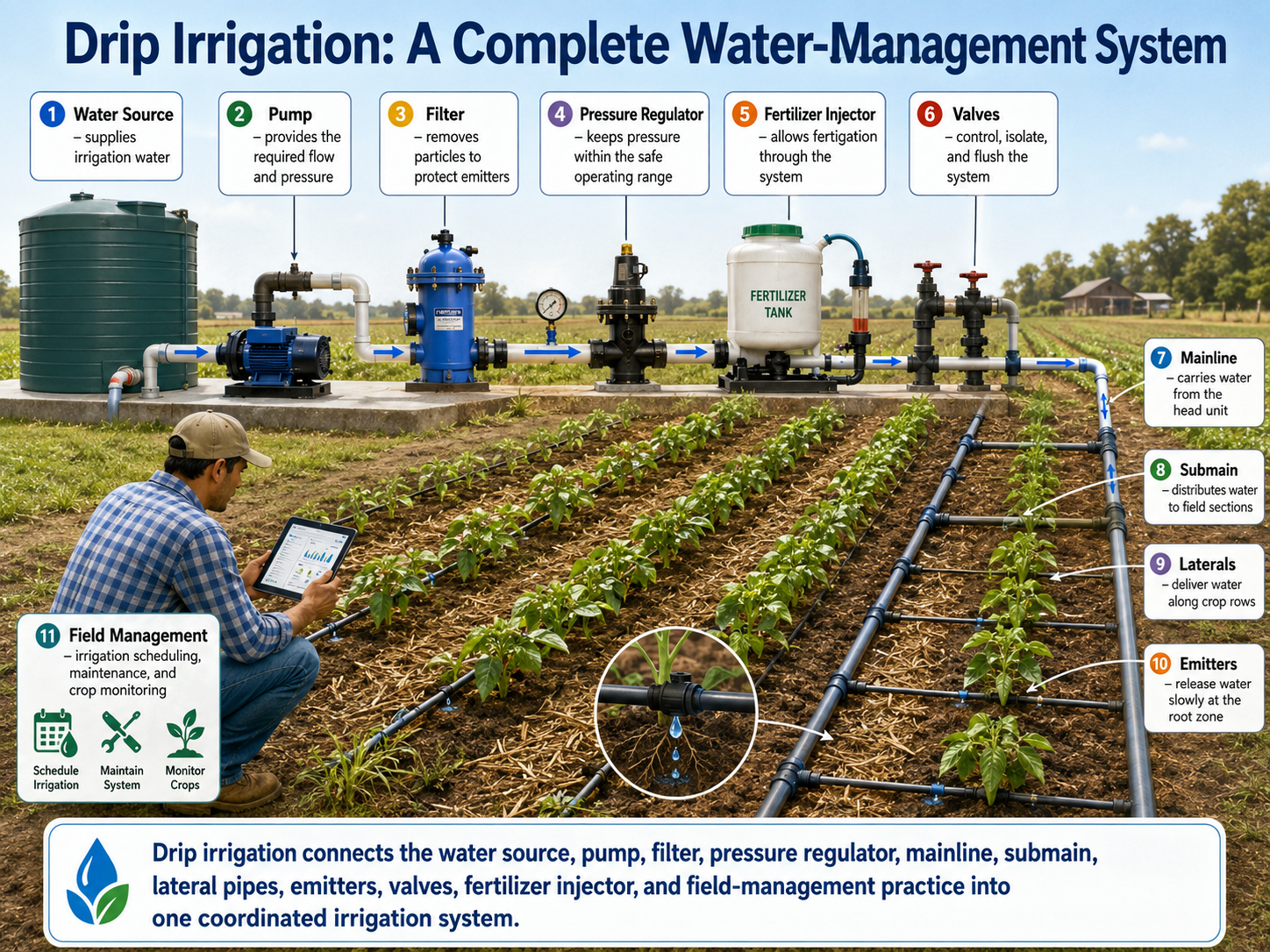
Drip irrigation is not only a pipe system. It is a complete water-management method. It connects the water source, pump, filter, pressure regulator, mainline, submain, lateral pipes, emitters, valves, fertilizer injector, and field-management practice into one coordinated irrigation system.
When properly designed and maintained, drip irrigation can help farmers save water, reduce labour, improve crop quality, apply fertilizer efficiently, control irrigation timing, and make agriculture more productive and resilient.
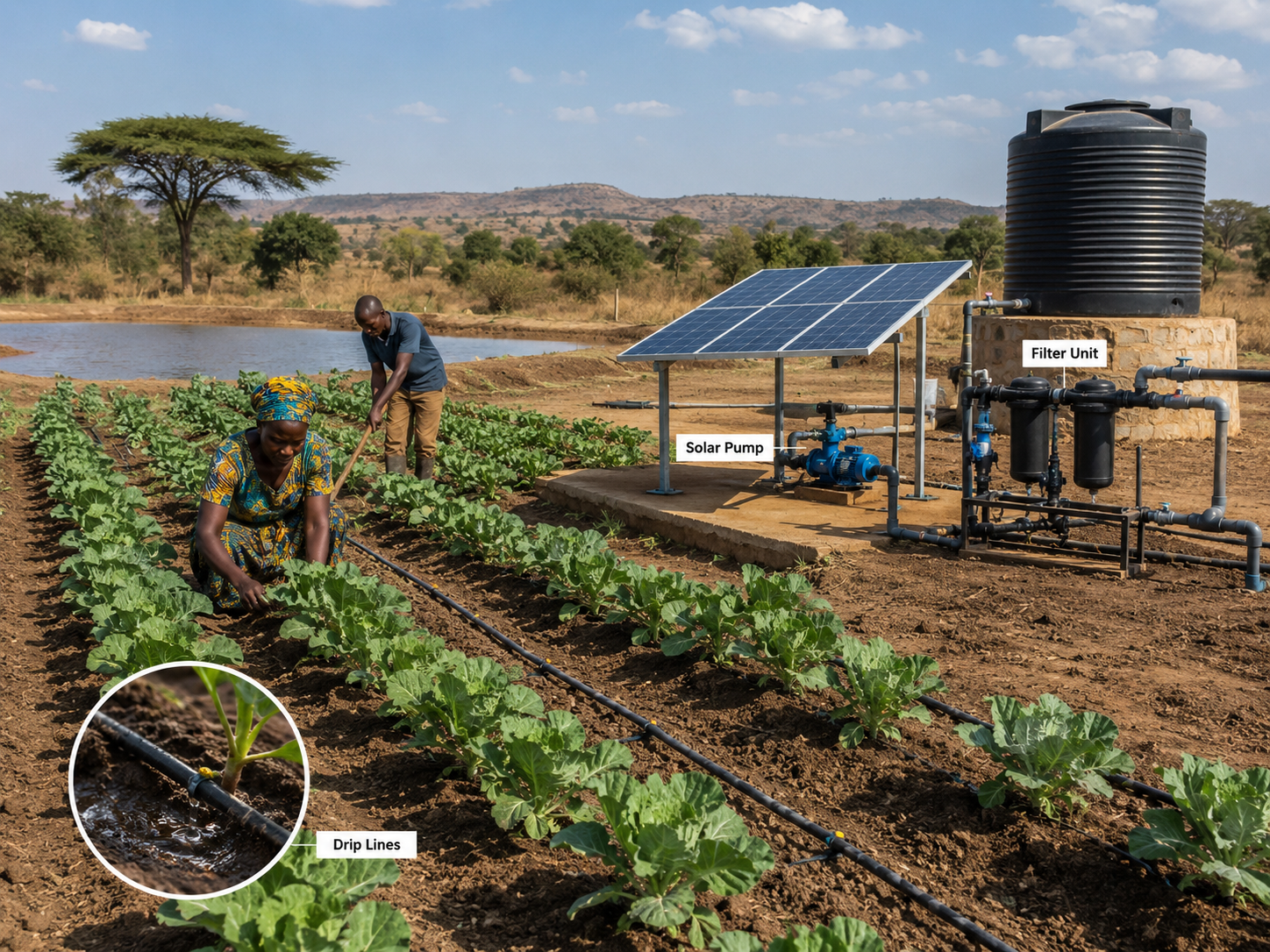
Solar-Powered Drip Irrigation in the Field
What Makes Drip Irrigation “Modern”?
A modern drip irrigation system is not just a set of plastic pipes placed in a field. It is a controlled irrigation system designed to deliver the right amount of water at the right place, at the right time, and under the right pressure.
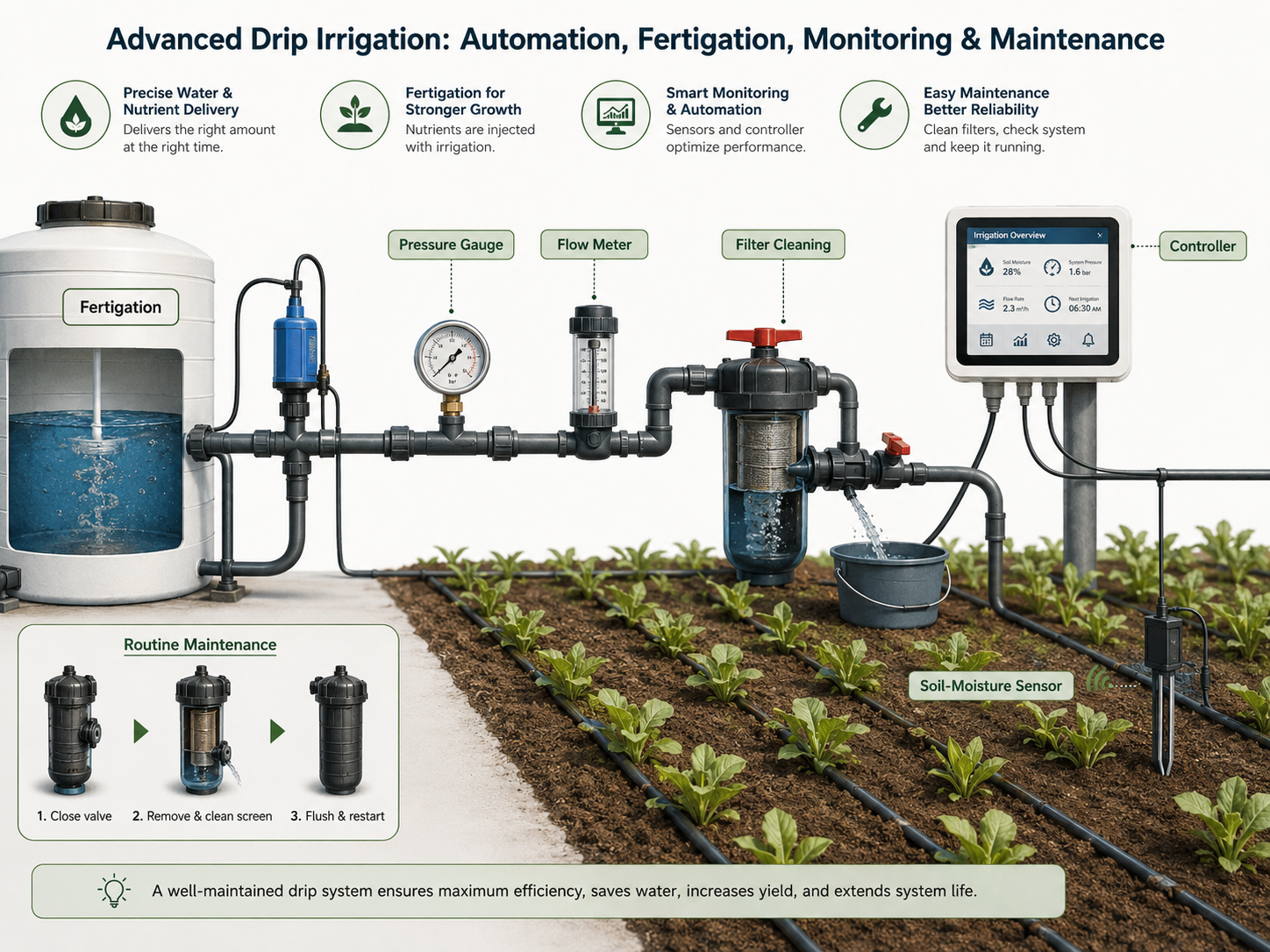
Modern drip systems may include high-quality emitters, pressure-compensating drippers, filtration units, pressure regulators, automatic valves, fertigation units, soil-moisture sensors, flow meters, solar-powered pumps, remote monitoring, and smart irrigation controllers.
In older irrigation methods, farmers often judge irrigation by visual observation or by flooding the field. In modern drip irrigation, water application can be calculated, scheduled, controlled, measured, and adjusted according to crop need, soil condition, weather, and available water.
This makes drip irrigation a bridge between traditional farming and smart agriculture.
Technology Fact Box
Technology: Drip Irrigation Systems
Main applications: Vegetable farming, fruit orchards, nurseries, greenhouses, smallholder irrigation, commercial farms, dryland agriculture, fertigation, and climate-resilient food production.
Common system components: Water source, pump, filter, pressure regulator, mainline, submain, lateral pipes, emitters, valves, fertilizer injector, flush valves, air-release valves, pressure gauges, and control units.
Main purpose: To deliver water directly to the plant root zone with controlled flow, reduced field losses, and improved irrigation efficiency.
Compatible technologies: Solar pumps, fertigation systems, soil-moisture sensors, automatic valves, smart controllers, remote monitoring systems, and internet-based field monitoring.
Main benefits: Water saving, better crop-water control, reduced weed growth, fertilizer efficiency, lower labour demand, improved crop quality, and suitability for dry regions.
Main risks if poorly designed: Emitter clogging, uneven pressure, poor filtration, pipe damage, salinity accumulation, wrong spacing, poor maintenance, and system failure.
Strategic value: Drip irrigation connects water saving, crop productivity, energy efficiency, fertigation, automation, and climate-resilient agriculture.
How Drip Irrigation Works
A drip irrigation system begins with a water source. This source may be a borehole, river, canal, lake, reservoir, storage tank, pond, or treated-water supply. The water is moved by gravity or by a pump into a head-control unit.
The head-control unit is the control center of the system. It normally includes filters, valves, pressure regulators, fertilizer injectors, pressure gauges, and sometimes flow meters or automation equipment.
From the head-control unit, water moves through main pipes and submain pipes. These pipes carry water to different irrigation blocks or zones. From the submains, water enters lateral pipes laid along crop rows. Emitters or drippers installed on the laterals release water slowly into the soil near the root zone.
The system works best when the pressure is stable, the water is clean, the emitters are not blocked, and the irrigation schedule matches the crop requirement.
Main Components of a Drip Irrigation System
A drip irrigation system has several important components. Each component has a specific role, and failure of one part can affect the whole system.
Water Source
The water source may be groundwater, surface water, harvested rainwater, treated water, or stored water. The quality and reliability of the water source are very important. Water with sand, silt, algae, iron, organic matter, or chemical deposits can clog emitters if filtration and treatment are not properly designed.
Pump
A pump is needed when water must be lifted, pressurized, or transported over a distance. The pump must be selected according to discharge, total dynamic head, field size, irrigation method, pipe length, elevation difference, and energy source. Solar pumps are especially useful in remote African farming areas where grid electricity is weak or unavailable.
Filtration Unit
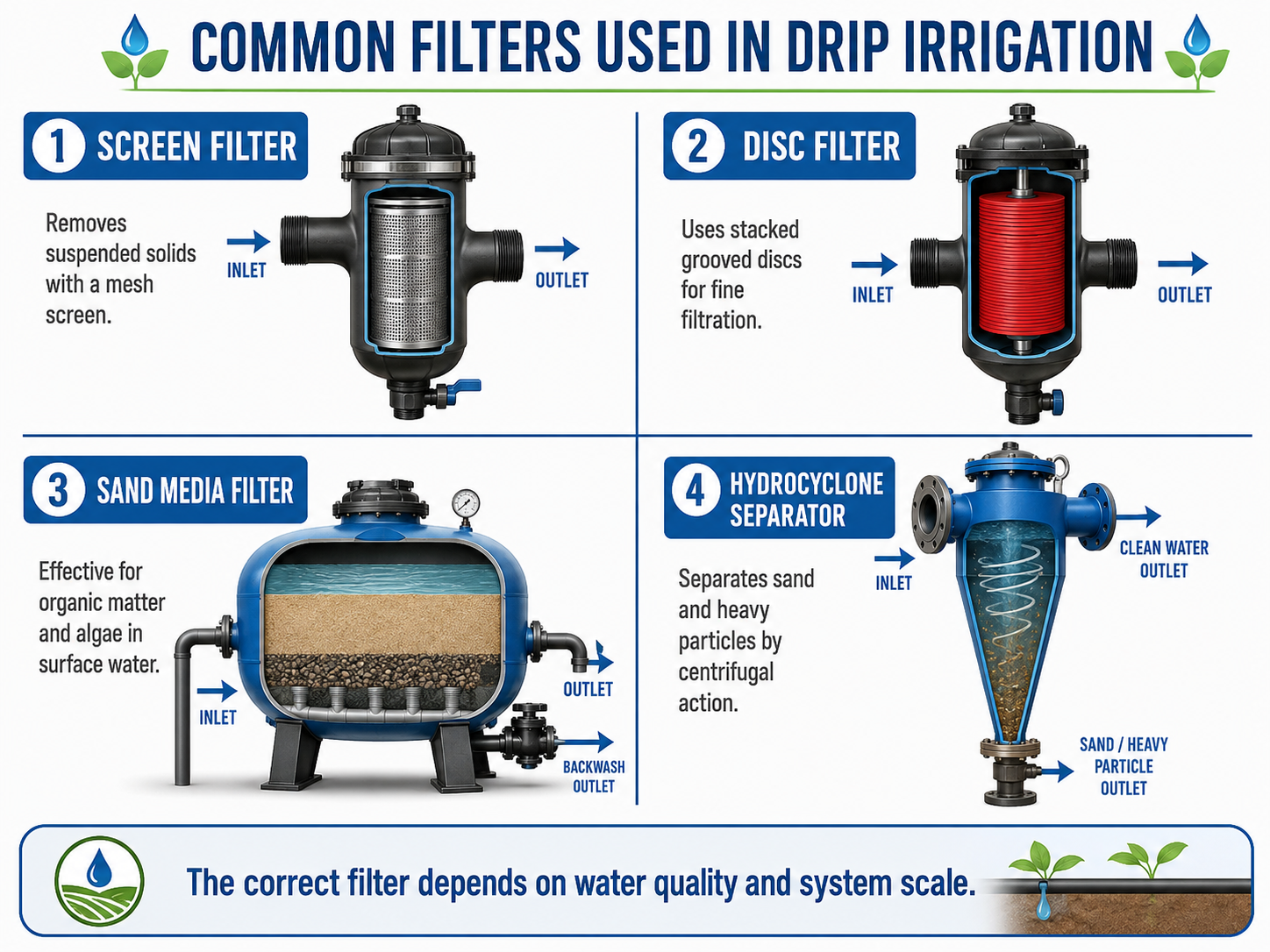
The filtration unit is one of the most important parts of a drip irrigation system. Emitters have small openings, and these openings can clog easily if water contains sand, algae, silt, organic matter, or chemical precipitates. Filters protect emitters and help maintain uniform water distribution.
Common filters include screen filters, disc filters, sand media filters, and hydrocyclone separators. The correct filter depends on water quality and system scale.
na
Pressure Regulator
Drip systems work within a specific pressure range. Too much pressure may damage pipes or emitters. Too little pressure may prevent uniform flow. A pressure regulator helps maintain the correct operating pressure and protects the system from pressure fluctuation.
Pressure Calculation and Pressure Control in Drip Irrigation
Drip systems work within a specific pressure range. If the pressure is too high, pipes, fittings, and emitters may be damaged or disconnected. If the pressure is too low, emitters may not discharge uniformly, and some plants may receive less water than others. For this reason, pressure calculation and pressure regulation are essential parts of drip irrigation design.
1. Basic Pressure Concept
In irrigation design, pressure is often expressed in:
bar, kPa, psi, metres of water head
Useful conversions:
1 bar ≈ 10.2 m water head
1 bar ≈ 100 kPa
1 psi ≈ 0.703 m water head
This means that if a drip emitter needs about 1 bar of pressure, it needs roughly 10 metres of water head at the operating point.
2. General Pressure Requirement
A drip system must have enough pressure to overcome:
- emitter operating pressure
- friction losses in lateral pipes
- friction losses in submains and mainlines
- filter head loss
- valve and fitting losses
- elevation difference
- losses through fertigation equipment
- safety allowance
The general formula is:
Required Pump Head = Emitter Operating Head+ Lateral Pipe Loss + Submain Loss + Mainline Loss + Filter Loss
+ Valve/Fitting Loss + Fertigation Loss + Elevation Difference + Safety Allowance
3. Example Calculation
Assume:
Emitter operating pressure = 1.0 bar
1.0 bar = 10.2 m head
Lateral pipe loss = 2 m
Submain loss = 2 m
Mainline loss = 3 m
Filter loss = 4 m
Valve and fitting loss = 1.5 m
Fertigation unit loss = 1.5 m
Elevation difference = 3 m
Total head before safety allowance:
10.2 + 2 + 2 + 3 + 4 + 1.5 + 1.5 + 3 = 27.2 m
Add 10% safety allowance:
27.2 × 1.10 = 29.9 m
So the pump should be selected to provide approximately:
30 m head
In pressure terms:
30 m ÷ 10.2 = 2.94 bar
Therefore, the pump should be able to supply about 3 bar at the required system flow rate.
4. Pressure at the Emitters
The most important pressure is not only the pressure at the pump. The important pressure is the pressure reaching the emitters.
If pressure at the pump is high but large losses occur in the mainline, filter, valves, and laterals, the emitter may still receive low pressure.
Therefore, the designer must check the pressure at:
- pump outlet
- after filtration
- after the pressure regulator
- submain inlet
- lateral inlet
- farthest emitter
The farthest emitter is very important because it normally receives the lowest pressure.
5. Pressure Regulator
A pressure regulator helps maintain the correct operating pressure downstream. It protects the drip system from pressure fluctuation and prevents damage to laterals and emitters.
For example:
If the pump produces 3 bar, but the drip laterals need only 1 bar to 1.5 bar, a pressure regulator can reduce and stabilize the pressure before water enters the drip laterals.
The pressure regulator should be selected according to:
- required downstream pressure
- system flow rate
- pipe size
- operating pressure range
- manufacturer recommendation
6. What Happens if Pressure is too High?
High pressure may cause:
- emitter discharge higher than designed
- pipe bursting or leakage
- fittings coming loose
- emitter damage
- non-uniform water application
- wasted water and energy
7. What Happens If Pressure Is Too Low?
Low pressure may cause:
- weak emitter discharge
- uneven irrigation
- dry areas near the end of laterals
- poor fertigation distribution
- crop stress
- low system efficiency
8. Good Engineering Practice
A good drip irrigation design should include:
- pressure gauge before and after the filter
- pressure gauge after the pressure regulator
- pressure check at the field block
- correct pump selection
- correct pipe diameter
- correct filter sizing
- correct regulator setting
- periodic flushing and maintenance
9. Simple Design Rule
The pump must provide enough pressure for the whole system, but the field laterals must receive only the safe operating pressure required by the emitters.
That is why pump selection and pressure regulation must work together.
Mainline and Submain Pipes
The mainline carries water from the pump or storage tank to the field. Submain pipes distribute water to different zones. The pipe diameter must be selected carefully to reduce friction losses and maintain pressure.
Lateral Pipes
Lateral pipes are the smaller pipes laid along crop rows. They carry water to the emitters. Their length, diameter, spacing, and pressure condition affect the uniformity of irrigation.
Emitters or Drippers
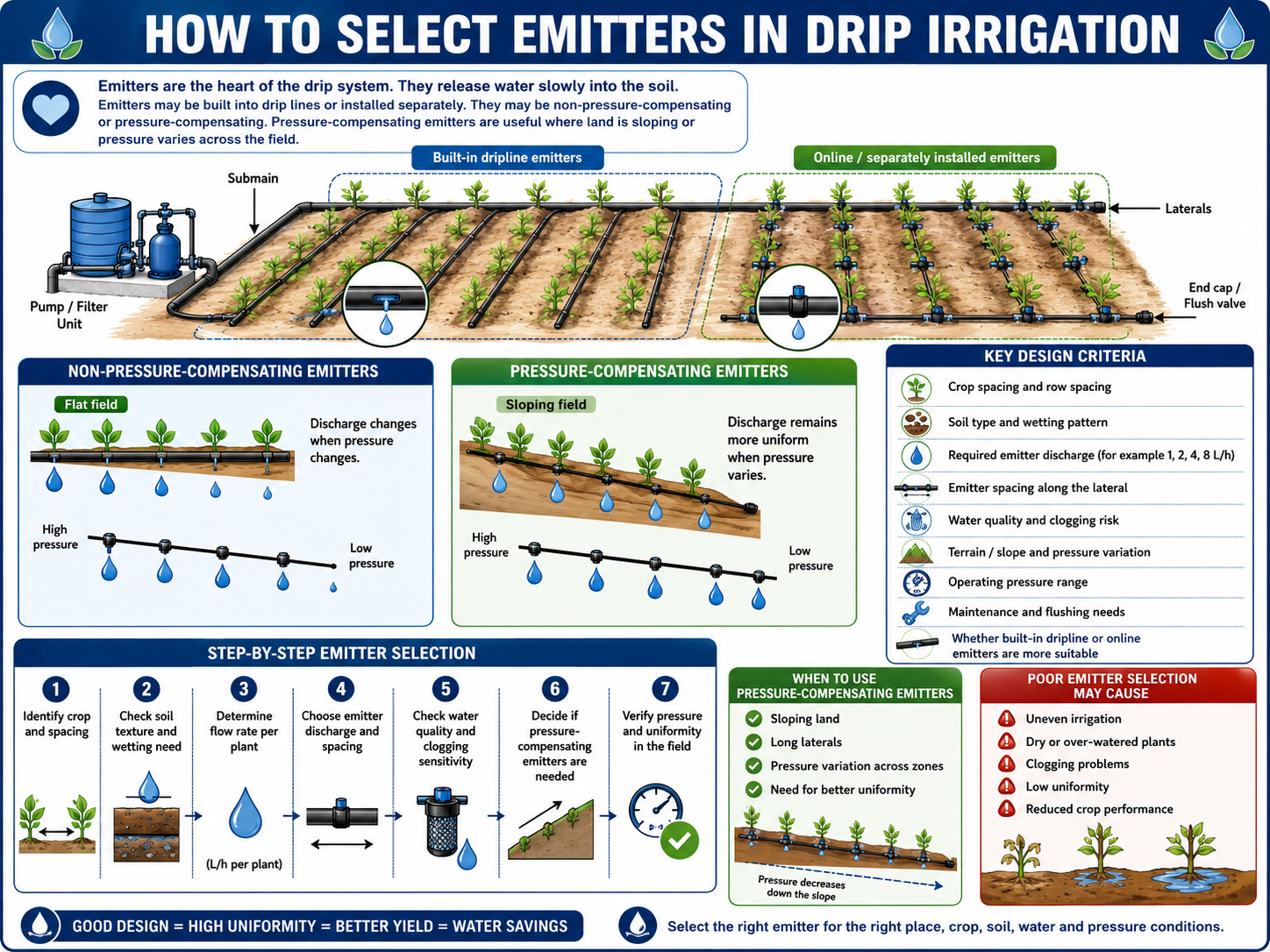
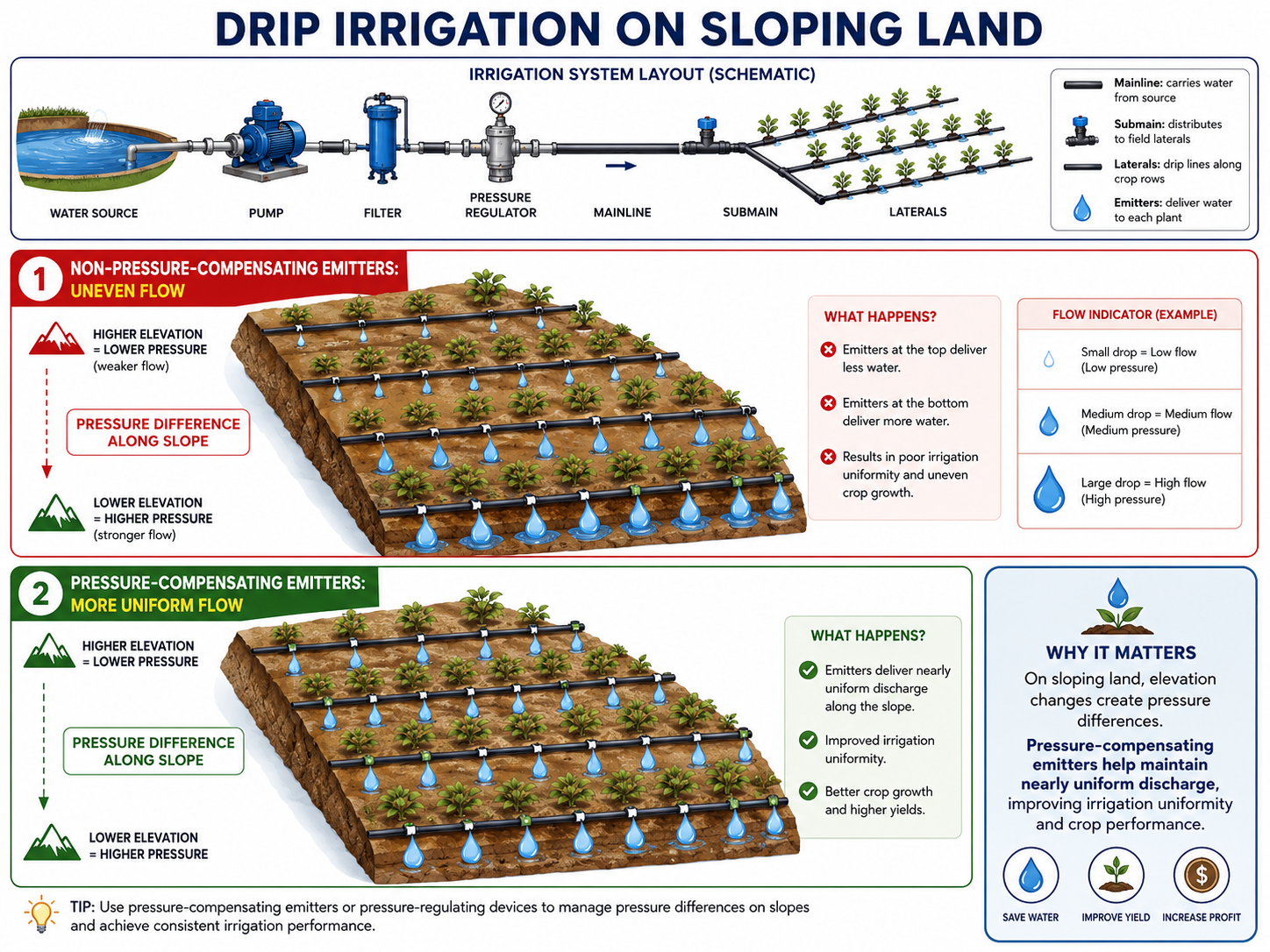
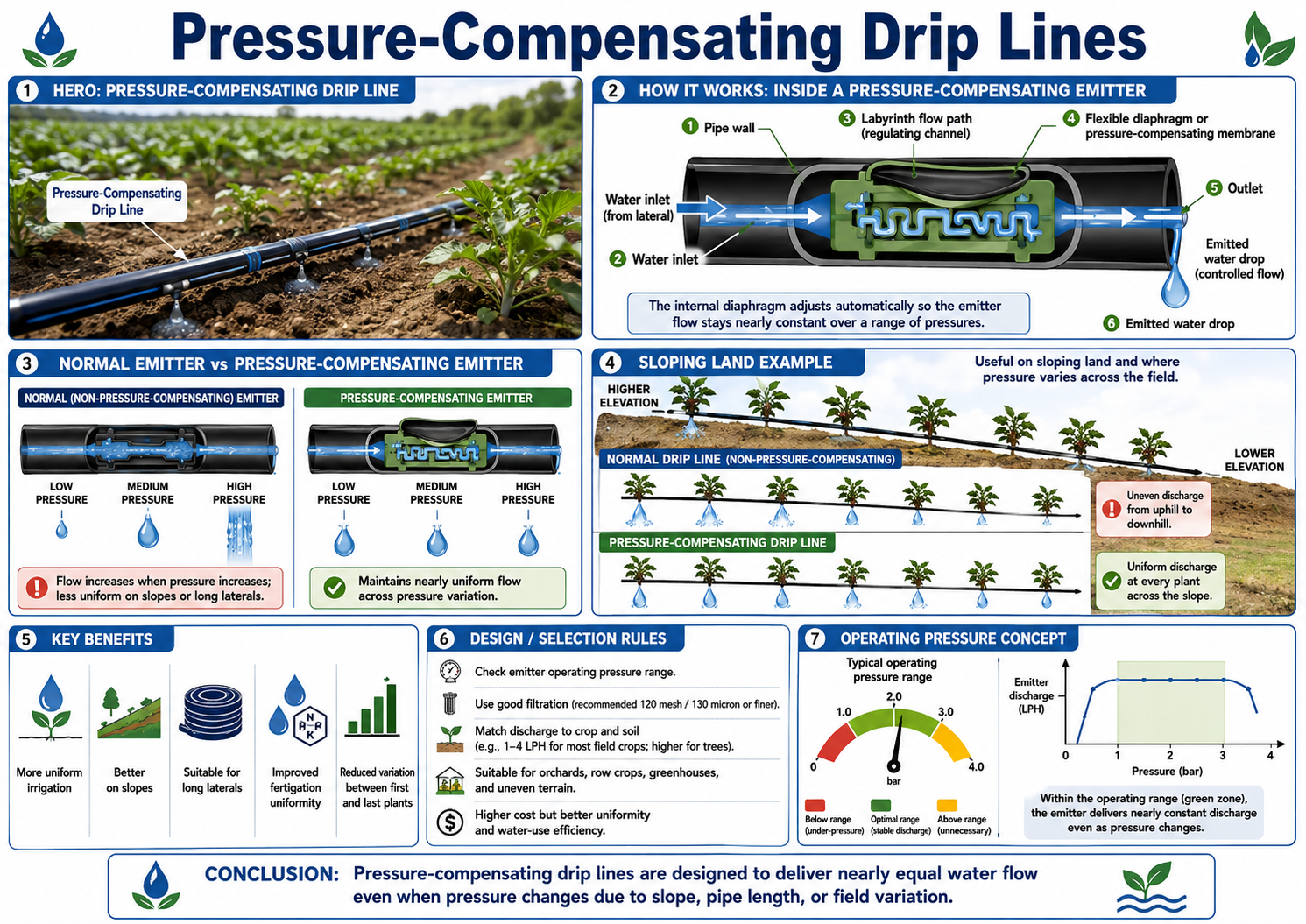
Emitters are the heart of the drip system. They release water slowly into the soil. Emitters may be built into drip lines or installed separately. They may be non-pressure-compensating or pressure-compensating. Pressure-compensating emitters are useful where land is sloping or pressure varies across the field.
Valves
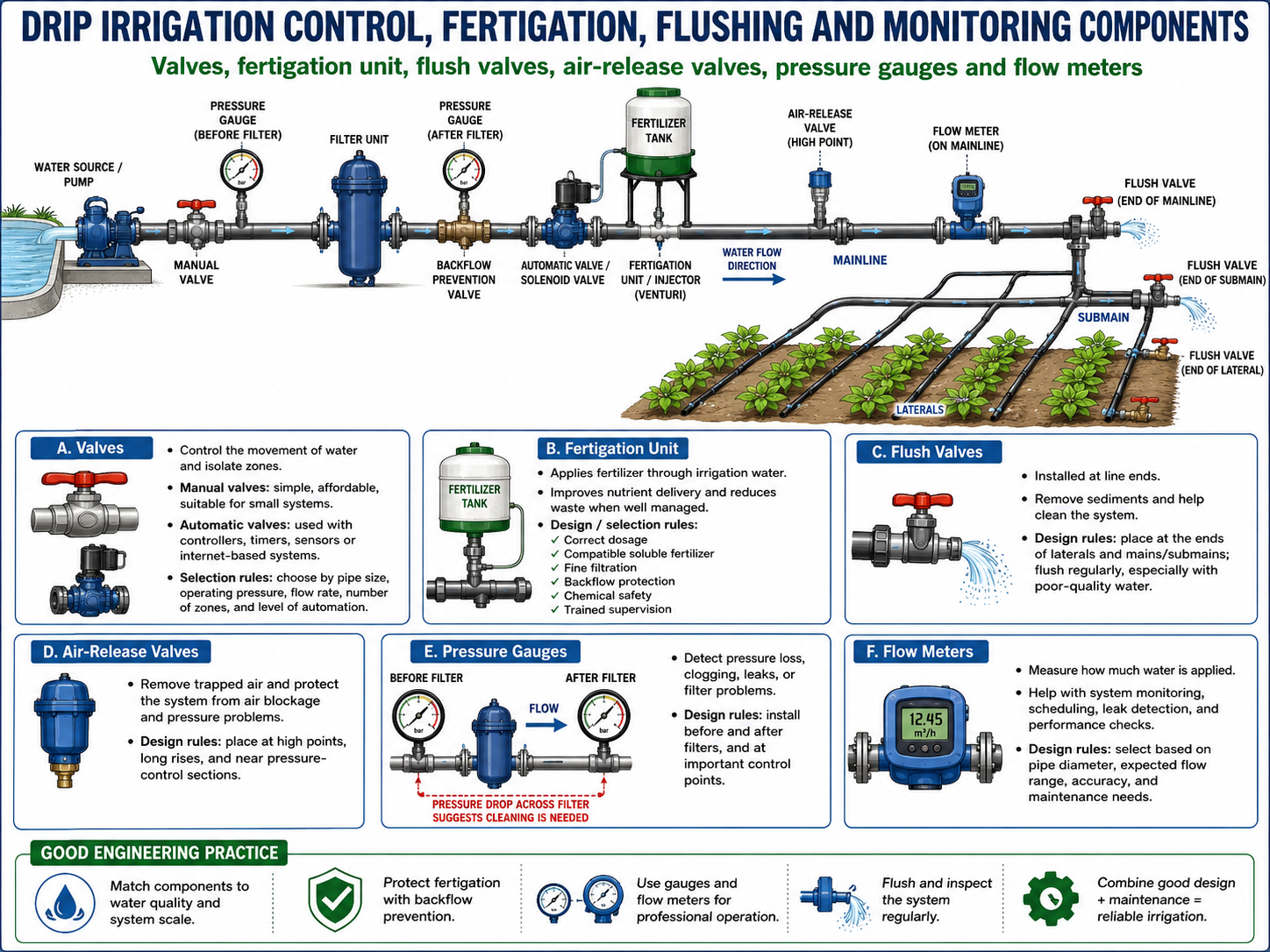
Valves control the movement of water. They allow the farmer or controller to open and close irrigation zones. Manual valves are simple and affordable. Automatic valves can be connected to controllers, sensors, timers, or internet-based systems.
Fertigation Unit
A fertigation unit allows fertilizer to be applied through the irrigation water. This can improve nutrient delivery and reduce waste if properly managed. However, fertigation requires correct dosage, filtration, backflow protection, safe chemical handling, and good supervision.
Flush Valves and Air-Release Valves
Flush valves help remove sediments from the ends of lateral and main pipes. Air-release valves remove trapped air from pipelines and protect the system from air blockage and pressure problems.
Pressure Gauges and Flow Meters
Pressure gauges help detect pressure changes, clogging, leaks, or filter problems. Flow meters help measure how much water is being applied. These instruments are important for professional operation and maintenance.
Why Drip Irrigation Matters for Africa
Drip irrigation matters for Africa because many regions face water scarcity, rainfall uncertainty, soil degradation, high fuel cost, and increasing food demand. Many farmers depend on rain-fed agriculture, but rainfall is becoming less predictable in many areas. When rainfall fails, crops fail.
Drip irrigation can help reduce this risk by allowing farmers to use available water more carefully. A small amount of water can be applied directly to the root zone instead of being lost through runoff, deep percolation, evaporation, or unnecessary wetting of bare soil.
For smallholder farmers, drip irrigation can support vegetable gardens, fruit trees, nurseries, greenhouse production, and high-value crops. For commercial farms, it can support large orchards, vineyards, horticulture, greenhouse systems, seed production, and export crops.
For institutions, schools, hospitals, refugee settlements, and community gardens, drip irrigation can help produce food with limited water and labour.
In Africa, drip irrigation is most powerful when it is combined with good training, local spare parts, affordable pumps, proper filtration, farmer support, and responsible water management.
Salient Points of Drip Irrigation Technology
The first salient point is precision. Drip irrigation delivers water near the crop root zone rather than spreading water across the whole field.
The second salient point is water saving. Because water is applied slowly and locally, field losses can be reduced when the system is properly designed and operated.
The third salient point is pressure control. Drip systems require stable pressure. Without pressure control, some plants may receive too much water while others receive too little.
The fourth salient point is filtration. Clean water is essential. Poor filtration can cause emitter clogging, uneven irrigation, crop stress, and system failure.
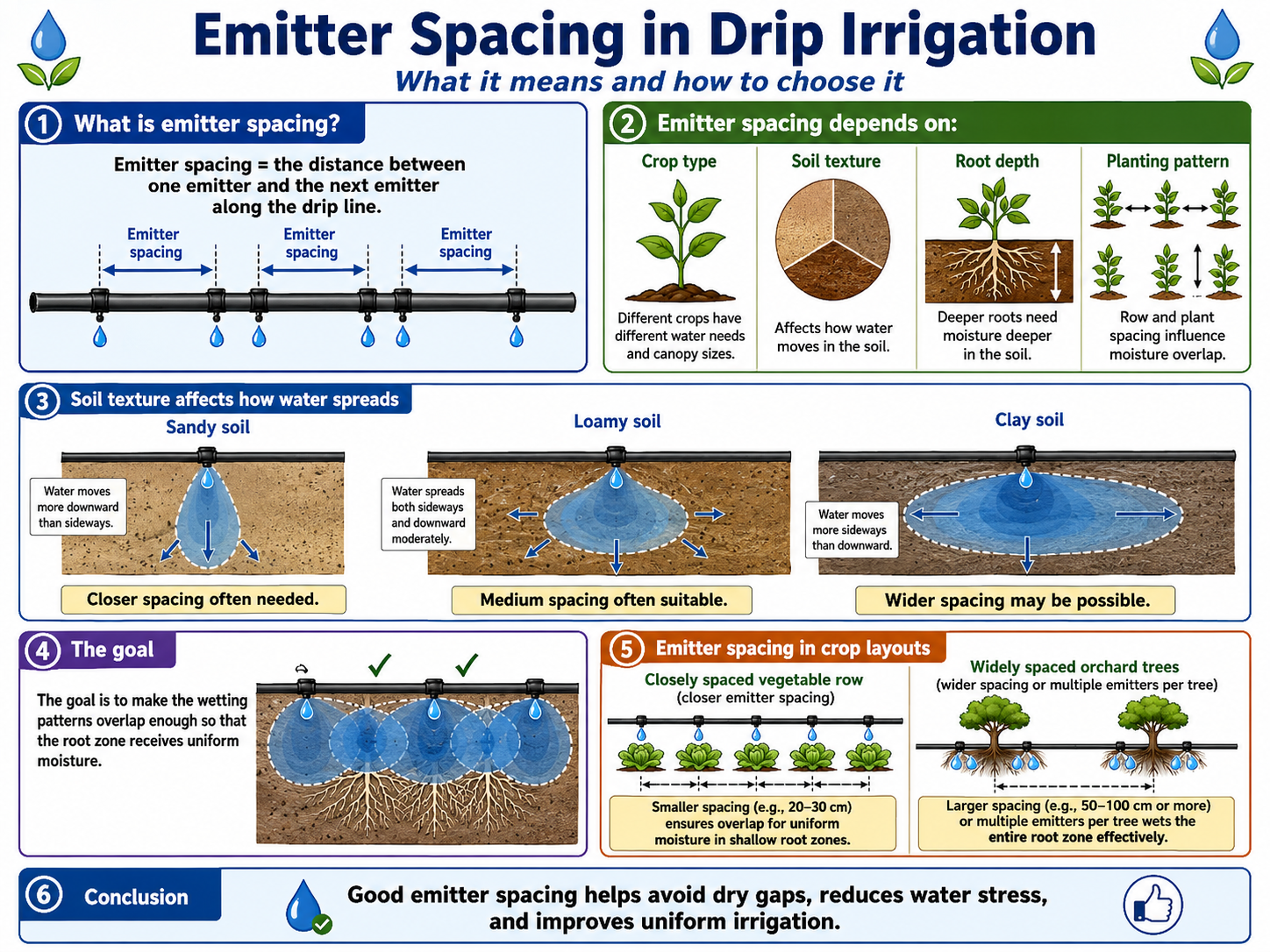
The fifth salient point is emitter spacing. Emitters must be placed according to crop type, soil texture, root depth, and planting pattern. Sandy soils may require closer spacing because water spreads less sideways. Clay soils may allow wider spacing because water spreads more laterally.
The sixth salient point is fertigation. Drip irrigation allows fertilizer to be delivered with water, but this must be done carefully to avoid over-application, clogging, or contamination.
The seventh salient point is automation. Drip systems can be connected to timers, soil-moisture sensors, valves, controllers, and remote monitoring. This makes them suitable for smart irrigation.
The eighth salient point is suitability for solar pumping. Drip irrigation often requires lower flow rates than many other systems, making it compatible with solar-powered pumping and storage-tank systems.
The ninth salient point is maintenance. Drip irrigation is efficient only when filters are cleaned, laterals are flushed, pressure is checked, and emitters are inspected.
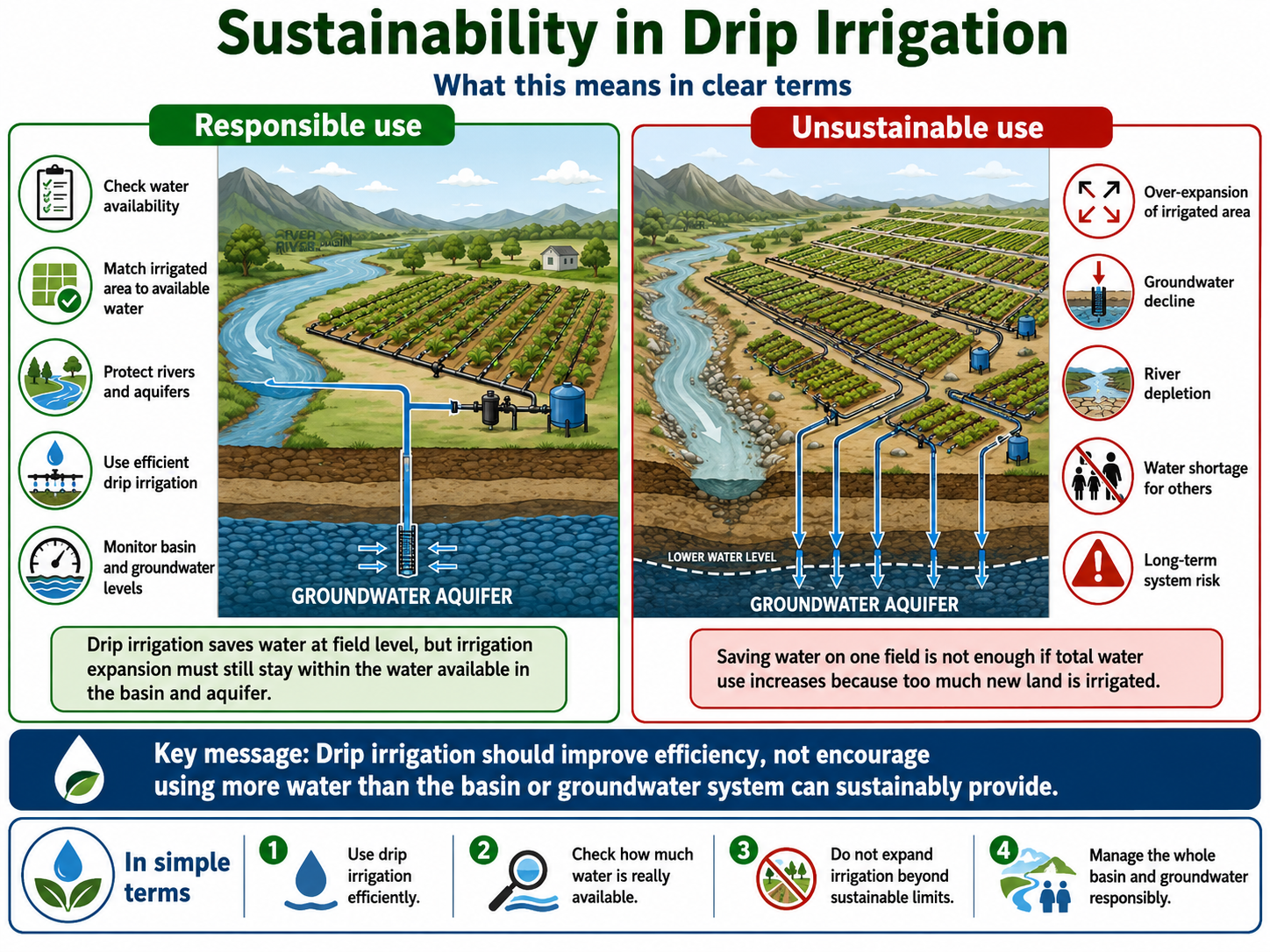
The tenth salient point is sustainability. Drip irrigation should not be used as an excuse to over-expand irrigated area without checking water availability. Water saving at field level must be connected to responsible basin and groundwater management.
Engineering and Design Considerations
Drip irrigation design begins with crop water requirement. The engineer or technician must estimate how much water the crop needs per day, how often irrigation should occur, and how much area will be irrigated.
The next step is to assess the water source. The water source must have enough quantity and acceptable quality. If the source is a borehole, the borehole yield and dynamic water level must be known. If the source is a river or canal, seasonal variation, sediment, intake protection, and pumping conditions must be considered.
The field layout is also important. The designer must decide the location of the pump, filter station, mainline, submain, valves, laterals, and flushing points. The system should be easy to operate, inspect, and maintain.
The pipe diameter must be selected according to flow rate and acceptable head loss. If pipes are too small, friction losses become high and pressure may drop. If pipes are too large, the system becomes more expensive than necessary.
Emitter spacing and emitter discharge must match soil and crop conditions. A vegetable crop may need different spacing than fruit trees. Sandy soil behaves differently from clay soil. Sloping land may require pressure-compensating emitters or careful zoning.
The pump must match the system requirement. It must provide the required discharge and pressure after considering elevation difference, pipe friction, filter losses, valve losses, and emitter pressure.
Good design must also include maintenance access. Filters should be accessible. Laterals should be easy to flush. Valves and pressure gauges should be located where operators can inspect them easily.
Drip Irrigation and Fertigation
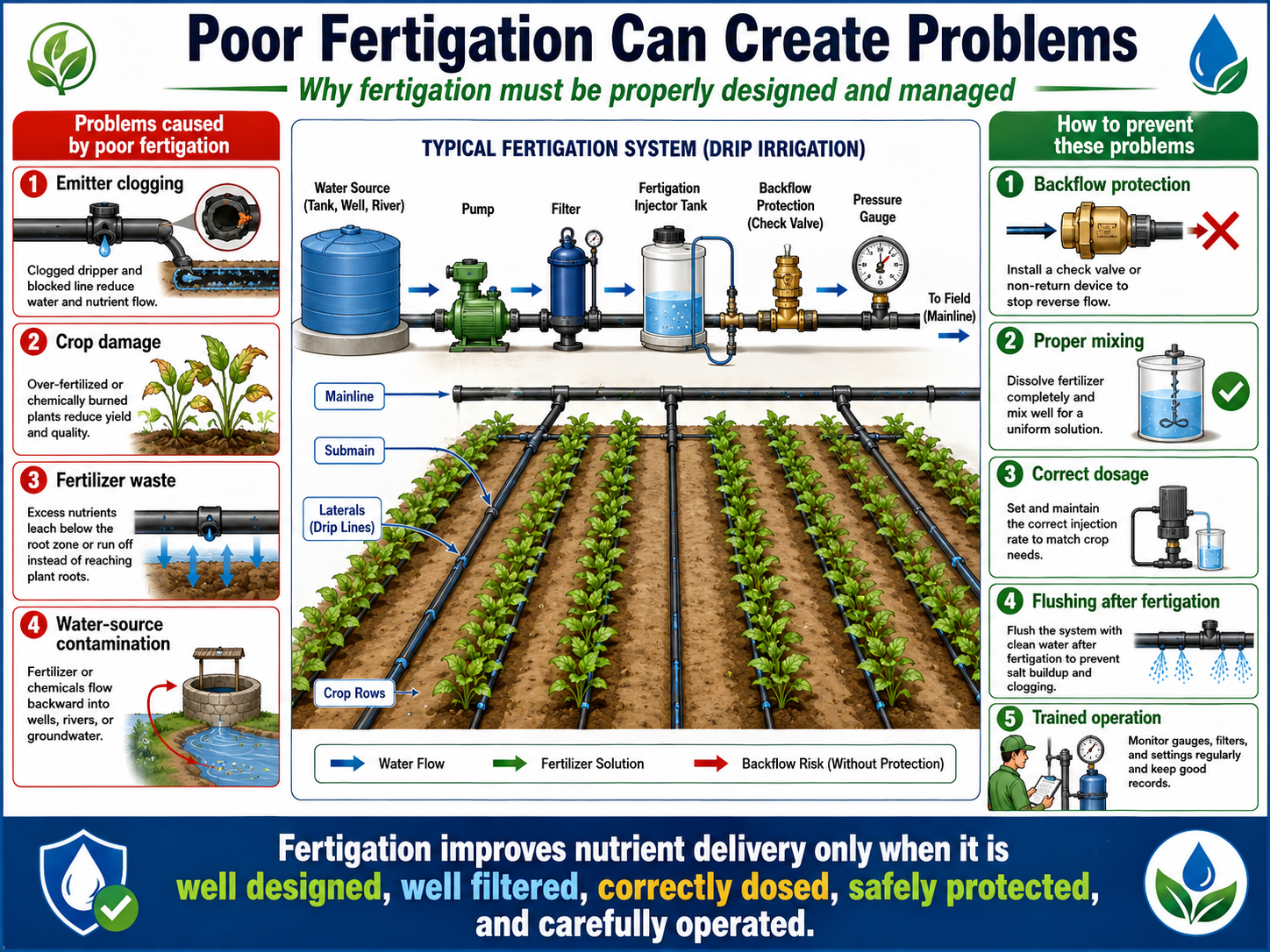
One of the strongest advantages of drip irrigation is fertigation. Fertigation means applying fertilizer through the irrigation water. This allows nutrients to reach the root zone more directly and can reduce fertilizer waste when carefully managed.
In fertigation systems, fertilizer is injected into the irrigation line using a dosing pump, venturi injector, fertilizer tank, or injection unit. The fertilizer must be compatible with the water quality and with the irrigation system.
Poor fertigation can create problems. It can clog emitters, damage crops, waste fertilizer, or contaminate water sources. Therefore, fertigation must be designed with backflow protection, proper mixing, correct dosage, flushing, and trained operation.
When managed well, fertigation can improve crop growth, reduce labour, and support high-value agriculture.
Drip Irrigation and Smart Agriculture
Drip irrigation is one of the best irrigation methods for smart agriculture because it can be controlled precisely.
A soil-moisture sensor can detect whether the crop root zone is dry. A controller can receive the data. Software can decide whether irrigation is needed. If the field requires water, the controller can start the pump and open the correct valve. Water then flows through the drip lines to the crop.
With internet-based monitoring, farmers or managers can receive information about pressure, flow, pump status, irrigation time, water use, and possible system faults. This is especially useful for large farms, greenhouses, irrigation schemes, and high-value crops.
Drip irrigation therefore becomes more powerful when combined with sensors, automation, solar pumps, and digital monitoring.
Operation and Maintenance
Drip irrigation systems require regular maintenance. A system that is not maintained will lose efficiency and may fail.
Filters must be cleaned frequently. Mainlines and laterals should be flushed to remove sediment. Pressure should be checked at different points. Emitters should be inspected to ensure that they are flowing properly. Leaks should be repaired quickly. Damaged laterals should be replaced. Fertigation lines should be cleaned after fertilizer application.
The operator should observe the crop and soil. If some plants look dry while others look healthy, the system may have pressure variation, blocked emitters, damaged pipes, or poor distribution.
Maintenance should include:
Cleaning filters regularly.
Flushing mainlines and laterals.
Checking pressure gauges.
Inspecting emitters.
Repairing leaks.
Checking valves.
Protecting pipes from animals and machinery.
Monitoring water quality.
Cleaning fertilizer injection equipment.
Recording irrigation time and water use.
Good maintenance is not optional. It is part of the technology.
Challenges and Risks
Drip irrigation has many benefits, but it also has risks.
The first risk is emitter clogging. This may be caused by sand, silt, algae, bacteria, iron, calcium deposits, fertilizer reactions, or poor filtration.
The second risk is poor pressure distribution. If pressure is not uniform, some crops receive more water and others receive less. This reduces crop uniformity and yield.
The third risk is poor design. If the pump is wrongly selected, pipes are too small, filters are inadequate, or emitters are wrongly spaced, the system will not perform well.
The fourth risk is poor maintenance. A drip system can fail if farmers do not clean filters, flush laterals, check pressure, or repair leaks.
The fifth risk is cost. Drip irrigation requires initial investment. Farmers may need support, financing, training, and reliable suppliers.
The sixth risk is salinity. Because drip irrigation wets only part of the soil, salts may accumulate near the edge of the wetted zone if leaching (Leaching is the downward movement of dissolved fertilizers, salts, or chemicals beyond the crop root zone. In drip fertigation, poor dosage or excessive irrigation can push nutrients below the roots, wasting fertilizer and potentially contaminating groundwater. Good fertigation design must therefore apply the right fertilizer dose with the right irrigation duration, followed by proper flushing without over-irrigating.) and water quality are not properly managed.
The seventh risk is over-expansion. When irrigation becomes efficient, farmers may expand the irrigated area. This can increase total water consumption if water resources are not managed carefully.
Which Drip Irrigation System is Best for African Farmers?
There is no single best drip irrigation system for every African farmer. The best system depends on water source, crop type, farm size, soil type, slope, budget, energy source, and maintenance capacity.
For very small farms, a low-cost gravity-fed drip system may be useful. Water can be stored in an elevated tank and distributed through small drip lines. This can work for gardens, nurseries, and vegetable plots.
For smallholder farmers with boreholes or shallow wells, a solar-powered pump combined with a storage tank and drip lines may be practical. The pump fills the tank during sunny hours, and irrigation can be applied later by gravity or low pressure.
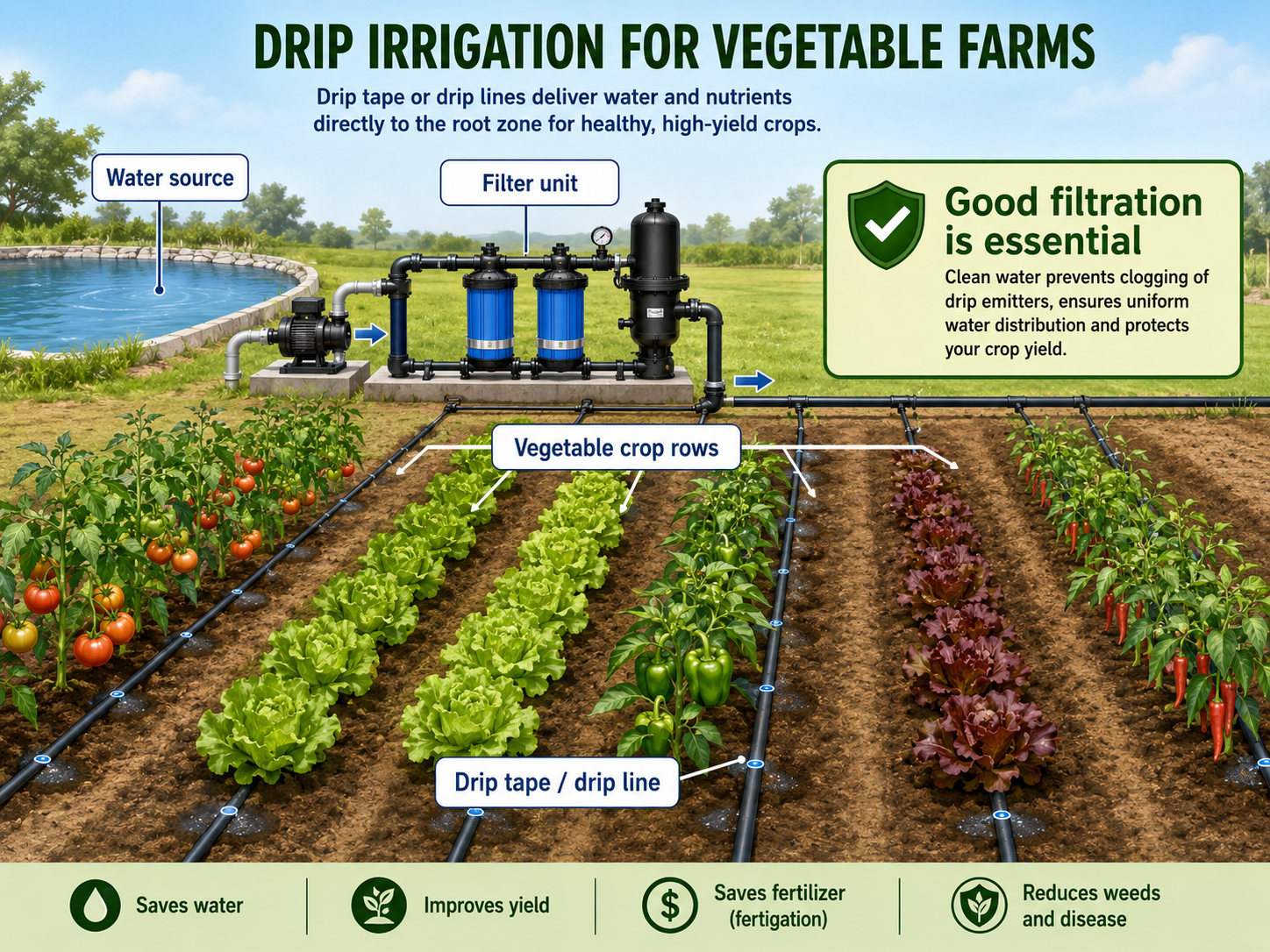
For vegetable farms, drip tape or drip lines can be used along crop rows. Good filtration is essential.
For orchards, permanent drip lines or pressure-compensating emitters may be better because trees require long-term irrigation and uniform water delivery.
For greenhouses, drip irrigation is especially useful because it allows careful control of water and fertilizer.
For commercial farms, automated drip systems with filters, fertigation, pressure regulation, sensors, flow meters, and remote monitoring may be appropriate.
For sloping land, pressure-compensating emitters are often useful because they help maintain more uniform flow despite pressure differences.
Practical Selection Summary
For a small vegetable garden, use a simple drip kit or gravity-fed drip system.
For a borehole-based farm, use a solar or electric pump with filtration, storage, and drip lines.
For a river or canal source, use a surface pump with strong filtration before drip irrigation.
For orchards, use durable drip lines or emitters designed for long-term operation.
For greenhouses, use drip irrigation with fertigation and pressure control.
For sloping land, use pressure-compensating emitters or divide the field into pressure zones.
For commercial farms, use automated drip irrigation with filters, fertigation, flow meters, and sensors.
For areas with dirty water, invest first in proper filtration before installing drip lines.
A practical drip irrigation system must always be selected according to crop need, soil texture, water quality, pressure requirement, available energy, farmer budget, and maintenance capacity.
Technical Note
Drip irrigation systems should be understood by component, flow rate, operating pressure, emitter spacing, filtration requirement, soil type, crop type, water quality, and maintenance need.
The main technical values are discharge, pressure, emitter flow rate, lateral length, pipe diameter, friction loss, filtration capacity, crop water requirement, irrigation frequency, and application uniformity.
Example:
Lateral Length estimation:
Pressure loss along the lateral ≤ allowable pressure variation
Normal text
Emitter discharge = 2 L/h
Emitter spacing = 0.30 m
Lateral length = unknown
If one lateral is 60 m long:
Number of emitters = 60 / 0.30 = 200 emitters
Total lateral flow: 200 × 2 L/h = 400 L/h
Convert:
400 L/h = 0.111 L/s
So the lateral inlet must carry about: 0.111 L/s
For drip lateral calculation, engineers commonly use:
Hazen-Williams equation or Darcy-Weisbach equation
Check pressure at the farthest emitter
Example:
Emitter operating pressure = 1.0 bar Lateral inlet pressure = 1.2 bar Allowable lateral pressure loss = 0.2 bar
Then: Pressure at end = 1.2 - 0.2 = 1.0 bar
But if the lateral loses 0.4 bar: Pressure at end = 1.2 - 0.4 = 0.8 bar
What controls maximum lateral length?
The lateral can be longer when:
pipe diameter is larger
emitter discharge is smaller
emitter spacing is wider
field is flat
Pressure-compensating emitters are used
operating pressure is sufficient
water is well filtered
The lateral must be shorter when:
pipe diameter is small
emitter discharge is high
emitters are very close together
field is sloping
pressure variation is high
water quality is poor
non-pressure-compensating emitters are used
The lateral length in a drip irrigation system is determined by the allowable pressure loss along the drip line. As water flows through the lateral, friction reduces pressure, while emitters discharge water continuously along the pipe. The designer must therefore calculate the total lateral flow, estimate friction loss, and confirm that the farthest emitter still receives enough pressure for uniform discharge. If pressure loss is too high, the designer may reduce lateral length, increase pipe diameter, reduce emitter discharge, use wider emitter spacing, divide the field into smaller zones, or select pressure-compensating emitters.
Maximum lateral length is reached when the pressure at the farthest emitter is still within the acceptable operating range.
A drip lateral should not be made long simply because the field row is long; it must be hydraulically checked so that emitters at the beginning and end of the line deliver nearly uniform water.
Lateral length = controlled by pressure loss, not only by field length.
Discharge means the quantity of water flowing through the system. It may be expressed in litres per hour, litres per second, cubic metres per hour, or cubic metres per day.
Pressure means the force that moves water through the pipes and emitters. Drip irrigation usually works at lower pressure than sprinkler irrigation, but the pressure must still be controlled carefully.
Emitter flow rate means how much water each dripper releases. Common emitter flow rates may be low, medium, or high depending on crop and soil condition.
Emitter spacing means the distance between drippers. It must match crop spacing and soil-water movement.
Filtration capacity means the ability of the filter to remove particles that could clog emitters.
Application uniformity means how evenly water is delivered across the field. A good drip system should deliver similar amounts of water to all plants in the zone.
A drip system is not selected by pipe colour or brand name alone. It is selected by matching the crop, soil, water source, pump, pressure, filtration, field layout, and maintenance capacity.
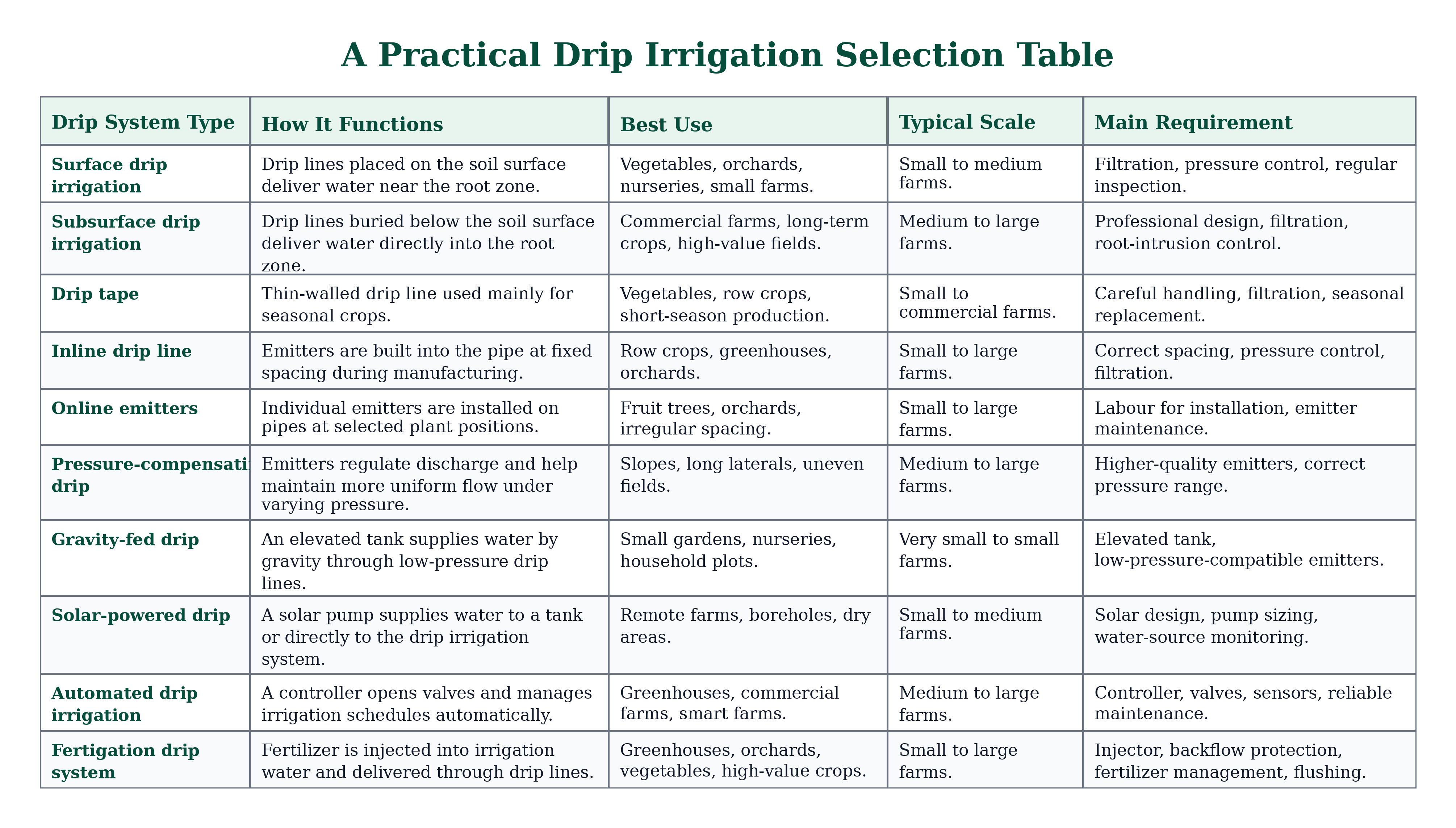
Types of Drip Irrigation Systems
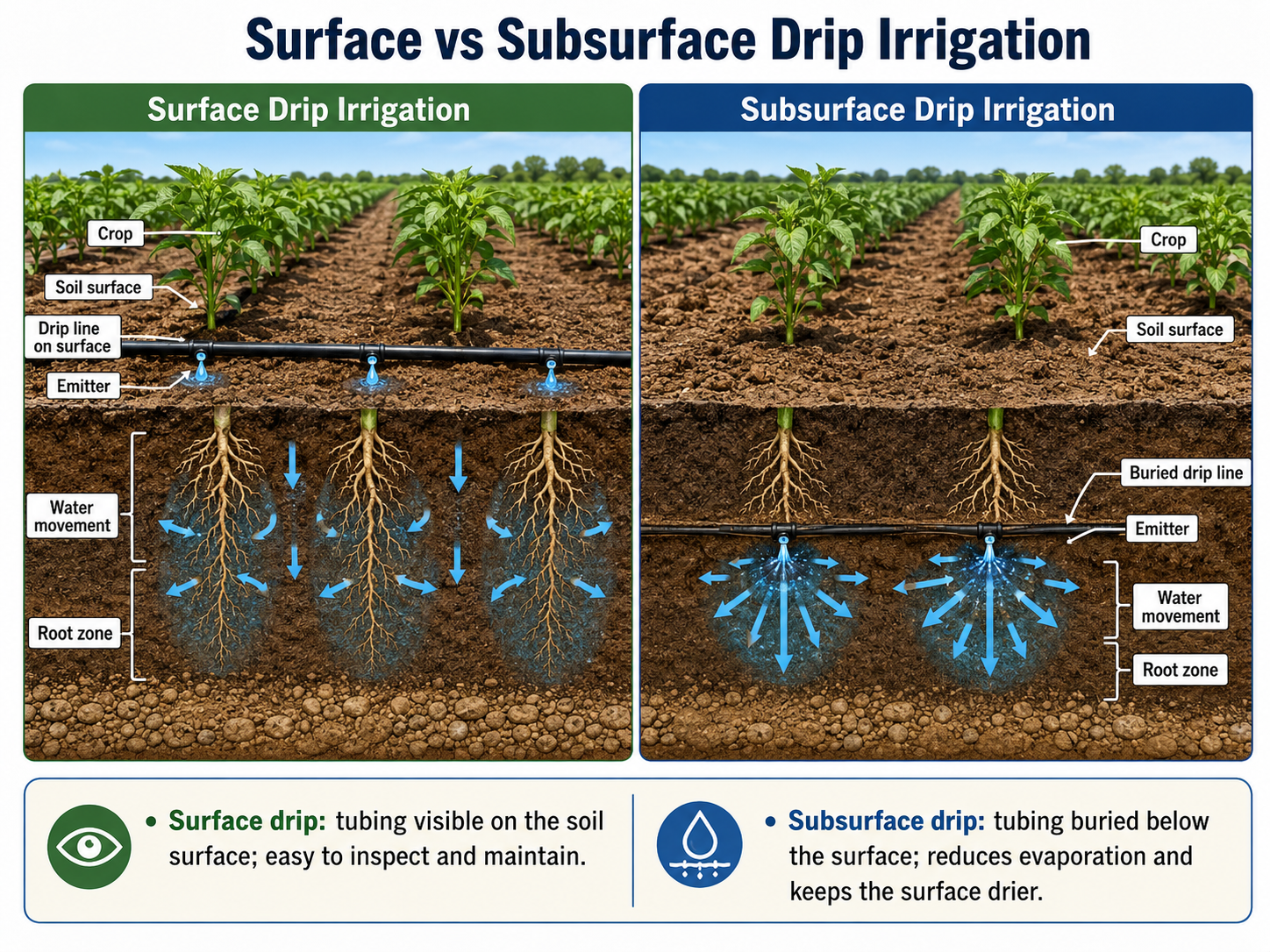
Surface Drip Irrigation
Surface drip irrigation places drip lines on the soil surface. It is easy to install, inspect, repair, and remove. It is common in vegetable fields, orchards, nurseries, and temporary irrigation systems.
Best use: vegetables, orchards, nurseries, and smallholder farms.
Main benefit: easy inspection and maintenance.
Main risk: damage by animals, workers, machinery, or sunlight.
Subsurface Drip Irrigation
Subsurface drip irrigation places drip lines below the soil surface. It can reduce surface evaporation and protect pipes from damage. However, it is harder to inspect and repair.
Best use: commercial farms, long-term crops, and carefully managed fields.
Main benefit: less surface interference and reduced evaporation.
Main risk: hidden clogging, root intrusion, and difficult maintenance.
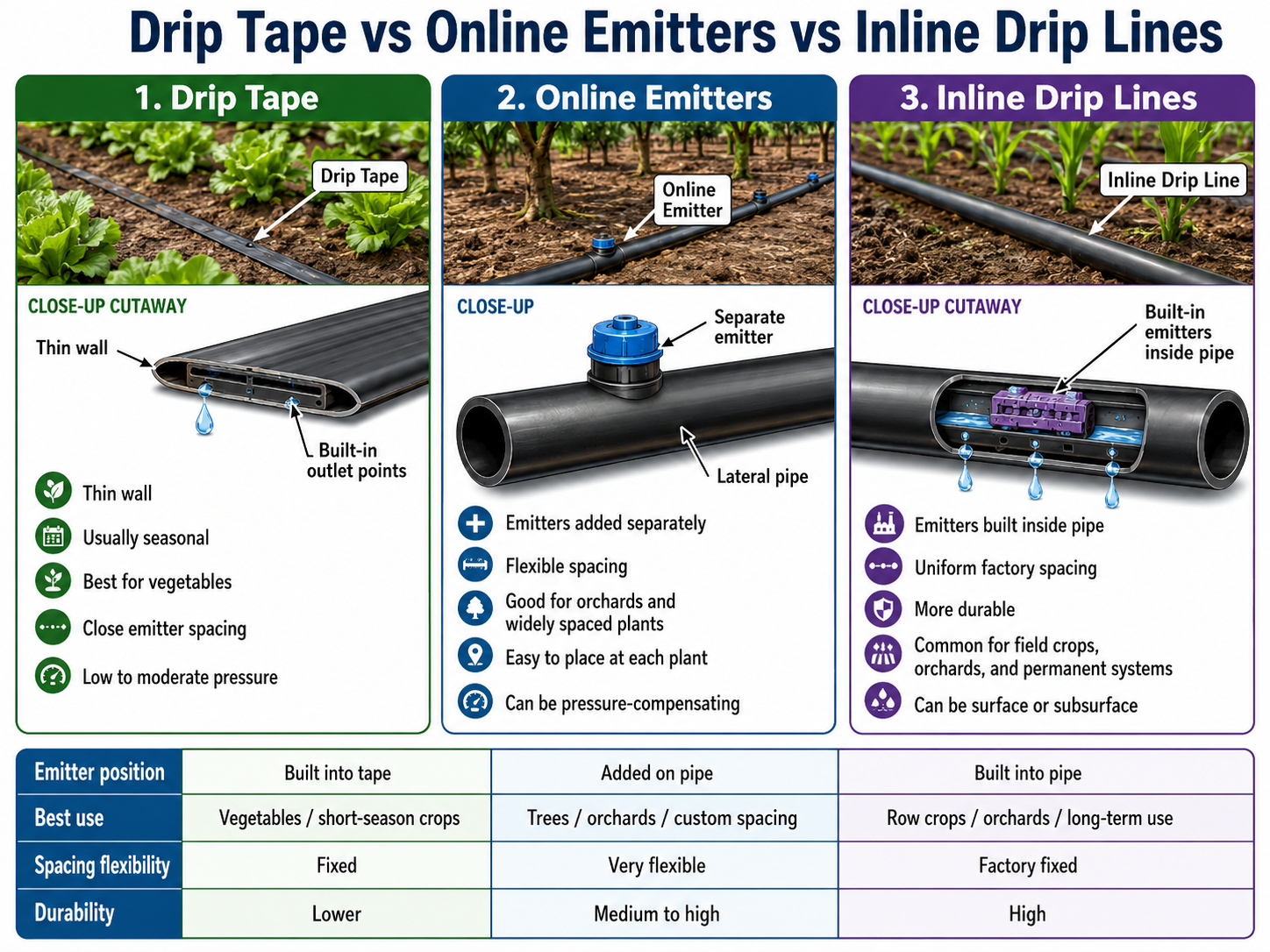
Drip Tape
Drip tape is a thin-walled drip line often used for seasonal crops. It is common in vegetable production and row crops.
Best use: seasonal vegetables and low-cost field systems.
Main benefit: affordable and easy to lay.
Main risk: shorter lifespan and higher damage risk.
Online Emitters
Online emitters are installed on pipes at selected points. They are useful for orchards, trees, and irregular plant spacing.
Best use: fruit trees, orchards, landscaping, and tree crops.
Main benefit: flexible emitter placement.
Main risk: more installation labour.
Inline Drip Lines
Inline drip lines have emitters built inside the pipe at fixed spacing. They are widely used in row crops, greenhouses, and orchards.
Best use: row crops, vegetables, greenhouses, orchards.
Main benefit: uniform spacing and easier installation.
Main risk: requires good filtration and correct pressure.
Pressure-Compensating Drip Lines
Pressure-compensating drip lines release nearly uniform flow over a range of pressures. They are useful on slopes, long laterals, and uneven terrain.
Best use: sloping land, orchards, large farms, and uneven fields.
Main benefit: better uniformity.
Main risk: higher cost.
Gravity-Fed Drip Systems
Gravity-fed drip systems use water stored in an elevated tank. They may work without an electric pump if the pressure requirement is low.
Best use: small gardens, household irrigation, nurseries, and community gardens.
Main benefit: low energy requirement.
Main risk: limited pressure and smaller coverage area.
Solar-Powered Drip Irrigation
Solar-powered drip irrigation combines solar pumps with drip lines. It is highly useful in rural areas without reliable electricity.
Best use: remote farms, smallholder irrigation, borehole irrigation, and dryland agriculture.
Main benefit: low operating cost after installation.
Main risk: groundwater overuse if pumping is not monitored.
Practical selection rule: Choose the drip system according to crop value, field layout, soil texture, water quality, pressure condition, labour capacity, maintenance ability, and long-term management goals. A technically advanced system is useful only when it is properly designed, filtered, operated, and maintained.
Why Drip Irrigation Deserves Attention
Drip irrigation deserves attention because it directly addresses one of the greatest challenges in agriculture: how to produce more food with limited water.
For Africa, the technology has special importance. It can help farmers move from rainfall dependence towards controlled production. It can support vegetable farming, fruit production, greenhouse agriculture, school gardens, community agriculture, and commercial irrigation.
It can also work well with other technologies that Africa needs: solar pumps, storage tanks, filters, sensors, automatic valves, fertigation systems, and internet-based monitoring.
However, drip irrigation should not be presented as a magic solution. It must be properly designed, installed, operated, and maintained. Farmers must understand filters, pressure, flushing, emitter clogging, water quality, irrigation timing, and system repair.
A good drip irrigation system can save water, reduce labour, improve productivity, and support climate resilience. A poorly designed system can clog, fail, waste money, and discourage farmers.
Conclusion
Drip irrigation systems are one of the most practical and powerful technologies for modern agricultural water management. They deliver water directly to the crop root zone, reduce unnecessary field wetting, support fertigation, work well with solar pumps, and create a strong foundation for smart irrigation.
For Africa, drip irrigation can help smallholder farmers, commercial farms, greenhouses, orchards, nurseries, and community agriculture become more productive and resilient. It can support food security, reduce dependence on unreliable rainfall, and help farmers manage scarce water more intelligently.
But the success of drip irrigation depends on correct design, proper filtration, pressure control, water-quality assessment, farmer training, maintenance, and responsible water use.
Drip irrigation is therefore not only a technology of pipes and emitters. It is a disciplined system of precision water management. When used wisely, it can help transform African agriculture toward efficiency, resilience, and sustainable development.
Solar-powered drip irrigation system in a vegetable field, showing how water is pumped, filtered, stored, and delivered through drip lines directly to crop rows. The image highlights the practical value of drip irrigation for African farms where solar energy, water saving, and reliable crop production are important.
Drip Irrigation Systems: Design Considerations, Equipment Selection, Water Quality, Fertigation, and Practical Engineering Guidance
Drip irrigation is one of the most efficient irrigation methods for delivering water directly to the crop root zone. It reduces evaporation losses, minimizes weed growth between rows, improves fertilizer-use efficiency, and allows precise control of irrigation timing and volume. However, the success of a drip irrigation system depends strongly on proper design, equipment selection, water quality management, filtration, pressure control, pipe sizing, and good operation and maintenance.
A well-designed drip system is not simply a set of pipes with emitters. It is a hydraulic and agronomic system that must be matched to the crop, soil, water source, field layout, topography, and management objectives. The designer must therefore approach drip irrigation step by step and ensure that every component of the system works together.
1. Key Design Considerations in Drip Irrigation
Before selecting any hardware, the designer should first define the basic design conditions. These include:
- crop type and planting geometry
- row spacing and plant spacing
- soil type and infiltration characteristics
- root depth and wetting pattern required
- climatic demand and evapotranspiration
- available water source and water quality
- field size, shape, and slope
- available energy source
- need for fertigation or chemigation
- required irrigation frequency and duration
These factors determine the total water requirement, number of emitters, emitter spacing, lateral spacing, discharge rate, pressure requirement, and total flow rate of the system.
2. Selection of Emitters and Orifice Size
One of the most important decisions in drip irrigation design is the selection of the emitter, also called the dripper. The emitter controls the discharge of water from the lateral pipe to the soil.
Common emitter discharges include:
- 1 L/h
- 2 L/h
- 4 L/h
- 8 L/h
The appropriate emitter discharge depends on soil texture, crop water requirement, and desired wetting pattern.
General guidance:
- Sandy soils: often require lower-duration but more frequent irrigation, and sometimes closer emitter spacing because water moves downward quickly and laterally less.
- Loamy soils: usually offer balanced vertical and lateral movement and are suitable for many standard drip layouts.
- Clay soils: allow wider lateral wetting but require careful management to avoid surface ponding and clogging effects.
Emitter orifice size is closely related to clogging risk. Very small orifices are more sensitive to clogging from suspended solids, biological growth, or mineral precipitation. For this reason:
- where water quality is poor, larger flow-path emitters or pressure-compensating anti-clog emitters are often better
- where pressure variation exists because of topography or long lateral runs, pressure-compensating emitters are often preferable
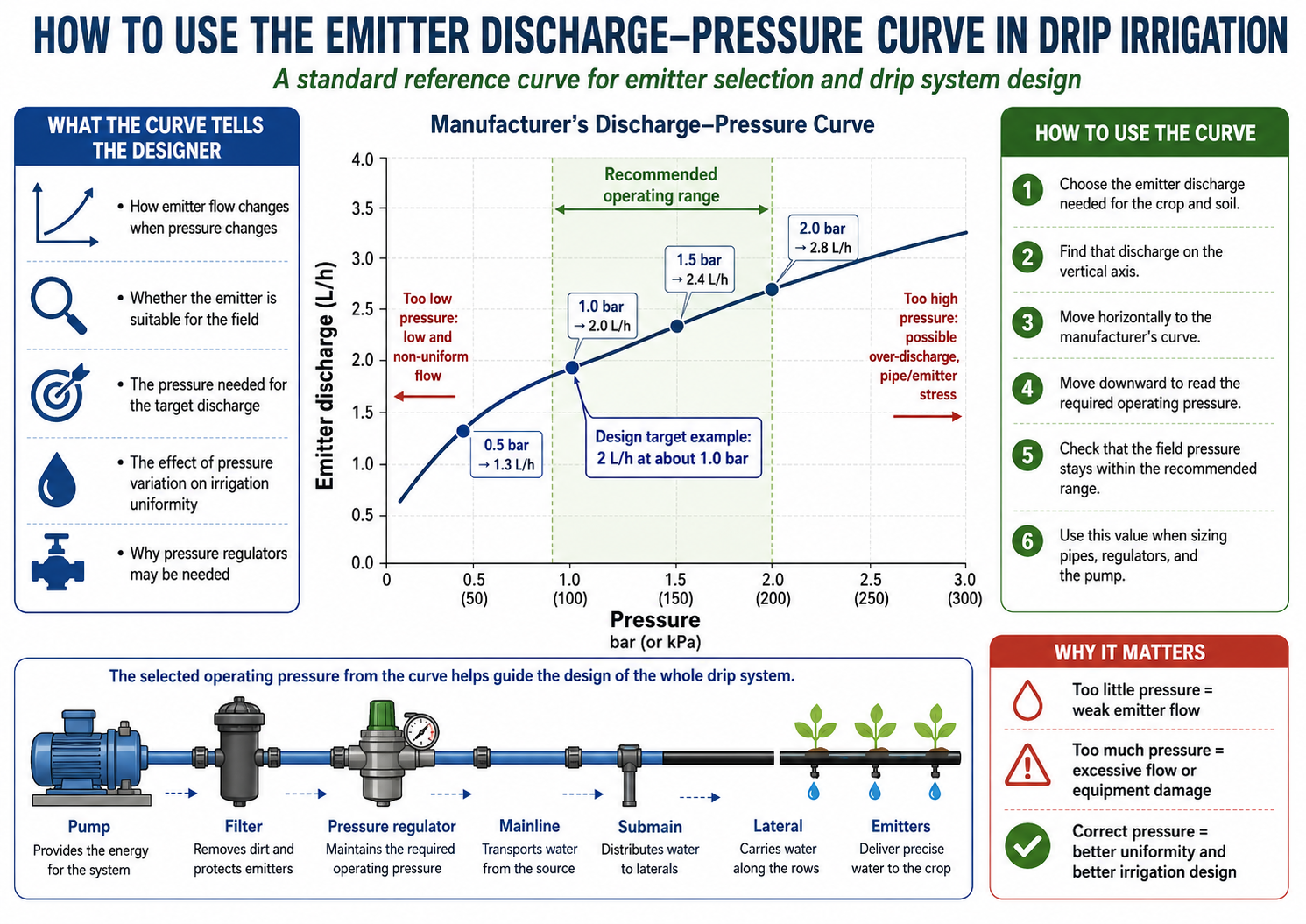
A designer should also consult the manufacturer’s discharge-pressure curve. This curve shows how emitter flow changes with pressure. It is one of the important standard reference curves in drip system design.
3. Pipe Selection: Which Pipe Is Better?
A drip system commonly includes:
- mainline
- submain
- manifolds
- lateral pipes
- emitter or dripline sections
The most common pipe materials are:
- HDPE for mainlines and submains
- LDPE or specialized dripline tubing for laterals
- PVC in some systems, especially where buried or rigid sections are needed
General practical guidance:
- HDPE is widely preferred for its flexibility, durability, corrosion resistance, and suitability for field conditions
- PVC may be suitable for fixed sections but is less flexible and more sensitive to certain handling conditions
- drip laterals are usually thin-wall or medium-wall polyethylene lines specifically designed for emitter installation or built-in driplines
Pipe selection depends on:
- operating pressure
- sunlight exposure
- installation method
- expected service life
- field mobility
- risk of damage from farm operations
4. How to Estimate Drip Pipe Diameter
Pipe diameter is determined hydraulically. It should be large enough to carry the required flow while keeping friction losses within acceptable limits.
The basic process is:
1. determine the flow rate in each section
2. choose an allowable water velocity
3. calculate a preliminary diameter
4. check head loss
5. revise if necessary
A simple velocity-based starting equation is:
D = √(4Q / πV)
Where:
- D = internal pipe diameter
- Q = discharge
- V = velocity
Typical desirable velocities in irrigation pipes are often moderate, because too high a velocity causes excessive head loss and too low a velocity may cause sedimentation problems.
After this initial estimate, head loss should be checked using accepted formulas such as:
- Hazen-Williams equation
- Darcy-Weisbach equation
Hydraulic Formulas Used in Drip Irrigation Pipe Design
In drip irrigation design, pipe diameter and lateral length should be checked hydraulically. Two common equations used for estimating friction loss in pipes are the Hazen-Williams equation and the Darcy-Weisbach equation.
1. Hazen-Williams Equation
The Hazen-Williams equation is commonly used in water-supply and irrigation pipe design. It estimates head loss caused by friction as water flows through a pipe.
A common SI form is:
hf = 10.67 × L × Q^1.852 / (C^1.852 × D^4.871)
Where:
hf = friction head loss in the pipe (m)
L = pipe length (m)
Q = flow rate through the pipe (m³/s)
C = Hazen-Williams roughness coefficient
D = internal pipe diameter (m)
Meaning:
This equation shows that head loss increases when the pipe is longer, when the flow rate is higher, or when the pipe diameter is smaller. It also shows that smoother pipes have lower friction loss.
Typical C values:
New plastic pipe such as PVC, PE, or HDPE: about 140–150
Older or rougher pipe: lower C value
Practical meaning for drip irrigation:
If the pipe diameter is too small, friction loss becomes high. This reduces pressure at the end of the lateral or submain and causes non-uniform emitter discharge. Increasing the pipe diameter reduces friction loss and helps maintain better pressure distribution.
2. Darcy-Weisbach Equation
The Darcy-Weisbach equation is a more general hydraulic equation. It can be used for many pipe materials and flow conditions.
The equation is:
hf = f × (L / D) × (V² / 2g)
Where:
hf = friction head loss in the pipe (m)
f = Darcy friction factor
L = pipe length (m)
D = internal pipe diameter (m)
V = average water velocity in the pipe (m/s)
g = gravitational acceleration, approximately 9.81 m/s²
Meaning:
This equation shows that head loss depends on pipe length, pipe diameter, water velocity, and pipe roughness. The friction factor f depends on the Reynolds number and the roughness of the pipe.
Practical meaning for drip irrigation:
Higher velocity causes much higher friction loss because velocity is squared in the equation. Therefore, drip irrigation pipes should be sized so that velocity remains within a reasonable range and pressure loss remains acceptable.
3. Simple Diameter Starting Formula
Before checking friction loss, a designer can estimate pipe diameter using the velocity equation:
D = √(4Q / πV)
Where:
D = internal pipe diameter (m)
Q = flow rate (m³/s)
V = selected design velocity (m/s)
π = 3.1416
Practical use:
First estimate the required pipe diameter using the expected flow rate and allowable velocity. Then check the friction loss using Hazen-Williams or Darcy-Weisbach. If the pressure loss is too high, increase the pipe diameter or reduce the lateral length.
4. Design Message for Drip Irrigation
In drip irrigation, the goal is not only to move water through pipes. The goal is to maintain enough pressure at every emitter so that each plant receives nearly the same amount of water.
Therefore:
Long pipe + small diameter + high flow = high friction loss and pressure drop
The designer should check the pressure at the farthest emitter because it usually receives the lowest pressure. If the farthest emitter still works within the recommended pressure range, the lateral or submain length is acceptable.
For laterals, the designer must also check pressure variation along the line, because emitter discharge depends on pressure. Excessive pressure drop causes non-uniform irrigation. Good drip design aims to maintain acceptable emission uniformity.
5. Pump Selection for Drip Irrigation
Selecting the pump is another critical design task. The pump must deliver:
- the required total discharge
- at the required operating head
- with adequate reliability and efficiency
The total dynamic head usually includes:
- suction head or lift
- static elevation difference
- pressure required at emitters
- friction losses in pipes and fittings
- losses through filters, control valves, fertigation equipment, and accessories
The designer should prepare a system head calculation and then select a pump whose pump characteristic curve matches the system demand. This is another important standard engineering curve used in irrigation design.
Good practice includes:
- selecting a pump near its efficient operating range
- avoiding oversized pumps that waste energy
- ensuring pressure is sufficient even after filtration and valve losses
- considering future expansion if needed
6. If the Water Source Is Groundwater
If groundwater is the water source, the following must be checked:
- safe yield of the well or borehole
- pumping water level and drawdown
- water quality
- sand content
- iron and manganese concentration
- salinity
- pH
- hardness and bicarbonate content
Groundwater often looks clean, but it can still contain dissolved minerals or fine particles that later cause clogging. Therefore, groundwater should not simply be assumed suitable without testing.
If groundwater contains:
- sand: sediment separation and screen protection are needed
- iron or manganese: aeration, oxidation, or chemical treatment may be required
- high bicarbonate or hardness: acid treatment may be needed in some cases
- biological contaminants: disinfection may be considered where appropriate
7. Water Quality Requirements for Drip Irrigation
Water quality is extremely important in drip irrigation because emitters have small passages.
Main water-quality concerns are:
- suspended solids
- algae and biological growth
- bacteria and slime formation
- iron and manganese
- calcium carbonate precipitation
- salinity
- pH and chemical compatibility
Poor water quality leads to:
- emitter clogging
- non-uniform application
- yield reduction
- increased maintenance cost
- shorter equipment life
The designer or operator should therefore perform water testing and establish a treatment and maintenance plan before the system is put into service.
8. Filtration: Which Filter Types Are Convenient for Drip Systems?
Filtration is essential in almost every drip system. The filter type depends on the source water quality.
Common filter types include:
a) Screen filters
These are simple and common. They are suitable where suspended solids are relatively low and water is reasonably clean.
b) Disc filters
These are very effective and widely used in drip systems. They provide fine filtration and are convenient for many agricultural applications. They are often preferred because they combine compactness with good filtration performance.
c) Media filters (sand or gravel filters)
These are especially useful where water contains high organic matter, algae, or biological impurities, such as surface water from rivers, ponds, or reservoirs.
In many systems, filtration is combined:
- hydrocyclone or sand separator first if sand is present
- media filter for organic matter if needed
- screen or disc filter as secondary polishing filter
This combined approach is often the most reliable for drip irrigation.
9. Valve Types Used in Drip Irrigation
Valves are used to control, regulate, protect, and isolate the system. Common valves include:
- gate valves or ball valves for isolation
- control valves for section management
- pressure-reducing valves to maintain safe downstream pressure
- air release valves to remove trapped air
- non-return or check valves to prevent backflow
- flush valves at the ends of submains and laterals for cleaning
- solenoid valves in automated systems
The right valve arrangement improves operational control, prevents damage, and makes maintenance easier.
10. Fertigation and Chemigation
Drip irrigation is especially powerful because it allows fertilizer and, where appropriate and safe, some agricultural chemicals to be injected into the irrigation water.
Fertigation means applying soluble fertilizers through the irrigation system.
Chemigation means injecting certain chemicals through the system under controlled conditions.
Advantages of fertigation:
- precise nutrient delivery near the root zone
- reduced fertilizer loss
- better nutrient-use efficiency
- ability to split applications over time
- improved crop response
Important practical rules:
- only fully soluble and compatible fertilizers should be used
- injection should occur after filtration and under controlled pressure conditions
- the system must be flushed after fertigation
- backflow prevention is essential
- fertigation schedules should match crop growth stages and nutrient demand
How often to fertigate:
- this depends on crop, soil, climate, and management plan
- in many drip systems, small frequent applications are better than infrequent heavy applications
- weekly or even more frequent applications may be suitable, depending on crop demand
- the exact schedule should be based on agronomic recommendations, crop stage, and irrigation interval
Chemigation requires additional caution:
- chemical compatibility with system materials must be verified
- operator safety must be ensured
- local regulations and environmental protection measures must be followed
- the system must include backflow prevention and proper flushing
11. Step-by-Step Drip Irrigation Design Procedure
A practical drip design sequence may be summarized as follows:
Step 1: Define crop and spacing Determine crop type, row spacing, plant spacing, root depth, and wetted area requirement. Step 2: Assess climate and crop water requirement Estimate evapotranspiration and peak crop water need. Step 3: Study the soil Determine soil texture, infiltration, water-holding capacity, and wetting behavior.
Step 4: Assess water source
Measure source capacity and test water quality.
Step 5: Select emitter type and discharge
Choose emitter discharge and spacing according to soil, crop, and desired wetting pattern.
Step 6: Determine number of emitters
Calculate emitters per plant, per row, and per block.
Step 7: Calculate total system discharge
Estimate discharge per lateral, per submain, and for the whole irrigation block.
Step 8: Size laterals, submains, and mainlines
Estimate diameters and check head losses.
Step 9: Select filtration system
Choose appropriate filter arrangement based on water quality.
Step 10: Select pump and control equipment
Determine pump discharge and head; select valves, pressure regulators, and accessories.
Step 11: Plan fertigation system
Select fertilizer injection method and safety components.
Step 12: Check pressure distribution and uniformity
Verify that pressure variation remains within acceptable limits for good emission uniformity.
Step 13: Provide flushing and maintenance provisions
Include end flush points, air valves, and cleaning arrangements.
Step 14: Prepare operation schedule
Define irrigation frequency, duration, fertilizer application schedule, and maintenance tasks.
12. Are There Standard Curves Used in Drip Irrigation Design?
Yes, several engineering and manufacturer reference curves are very useful in drip irrigation work. These include:
- emitter discharge versus pressure curve
- pump characteristic curve
- system head curve
- filter head-loss curve
- soil moisture or infiltration response relationships
- sometimes crop-water requirement or irrigation scheduling curves
There is not just one universal “standard curve” for the whole drip system. Instead, the design relies on several curves, charts, and hydraulic checks.
13. Empowering Engineers in Drip Irrigation
This field requires strong engineering judgment. Engineers working in drip irrigation must understand:
- hydraulics
- soil-water-plant relationships
- filtration and water quality
- pumping systems
- fertigation and system control
- operation and maintenance
- economics and field practicality
By combining these areas, engineers can design systems that are efficient, reliable, economical, and well adapted to local conditions. In Africa and other regions where water efficiency is increasingly critical, skilled drip-irrigation engineers have an important role to play in improving productivity, reducing water loss, and strengthening climate resilience.
14. Conclusion
Drip irrigation is one of the most advanced and efficient irrigation methods available, but its success depends on correct design and disciplined operation. Proper emitter selection, pipe sizing, pump matching, filtration, water-quality control, valve arrangement, fertigation planning, and maintenance are all essential. A step-by-step engineering approach helps transform drip irrigation from a simple concept into a reliable and productive field system.
When well designed, drip irrigation can save water, improve yields, reduce fertilizer losses, and support modern sustainable agriculture. It is therefore not only an irrigation method, but also a powerful engineering tool for precise and intelligent water management.
Comments are reviewed by AquaLinked Media before public display.
If your email matches an approved AquaLinked expert profile, your comment may appear with your expert profile link after approval.
No approved comments yet. Be the first to contribute respectfully.
Registered AquaLinked expert?
No password is needed. Enter the email connected to your expert profile,
and the system will check whether your expert profile exists.
Get African water, irrigation, WASH, climate-resilience, engineering,
and expert updates directly from AquaLinked.
Subscribe for updates
Receive important AquaLinked Media updates, new articles, expert news,
and platform announcements by email.
You can unsubscribe later from AquaLinked email updates.
Install the mobile app
The yellow desktop button only opens the mobile platform.
To complete installation on your phone, open the mobile platform
and tap the green Install App button at the top.
After installation, AquaLinked Media can be opened directly like an app.
Privacy Preferences
AquaLinked Cookie Preferences
AquaLinked uses essential cookies and local browser storage to support security,
remember preferences, improve user experience, and understand platform activity.
You can accept all cookies or manage your preferences.
Essential cookies
Required for login, security, forms, and basic website functions.
Preference cookies
Remember language, display choices, and comfort settings.
Analytics cookies
Help AquaLinked understand visits and improve pages.
Marketing cookies
May support future advertising, sponsors, and platform growth.
 Solar-Powered Drip Irrigation in the Field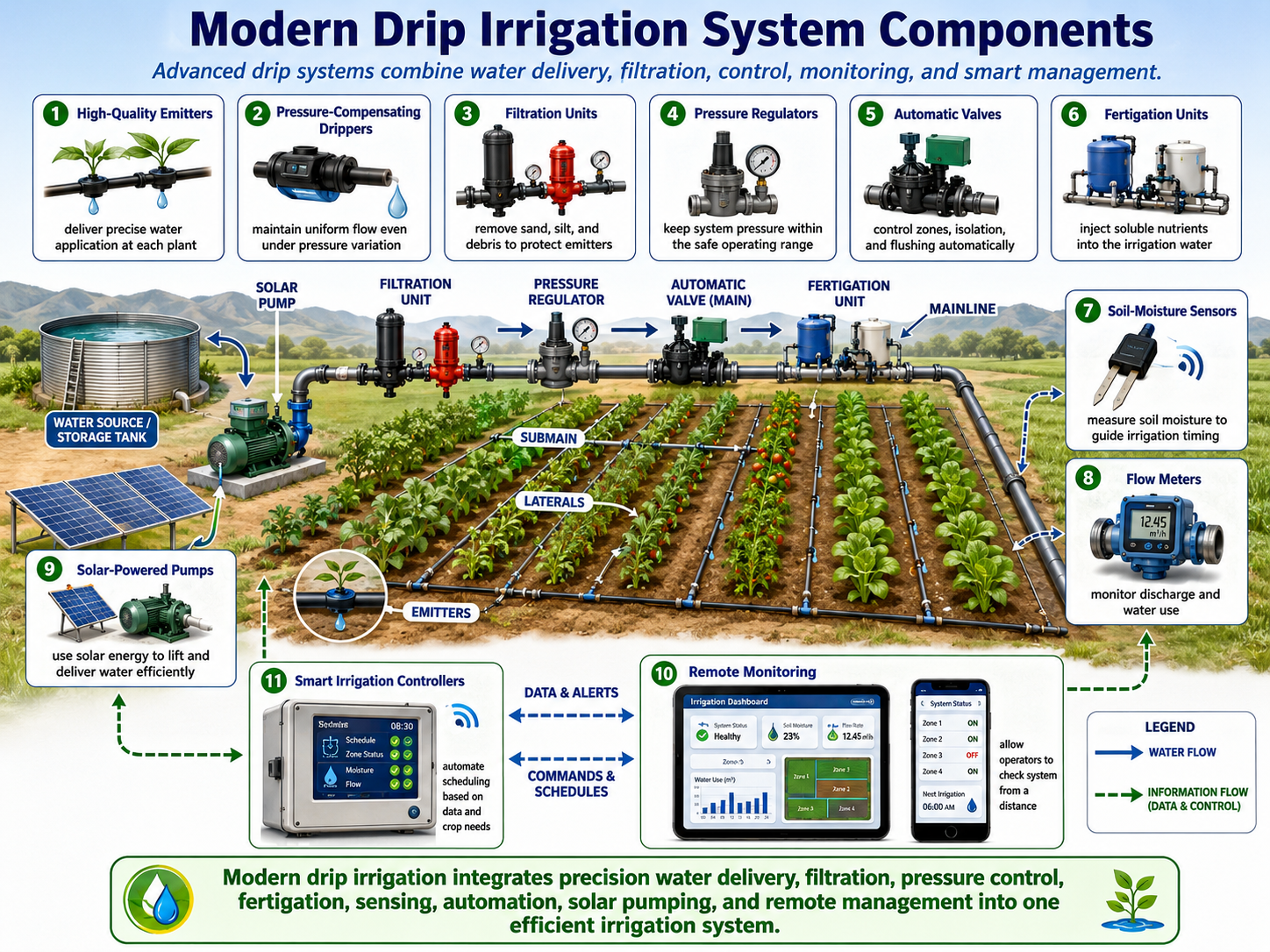
 na
na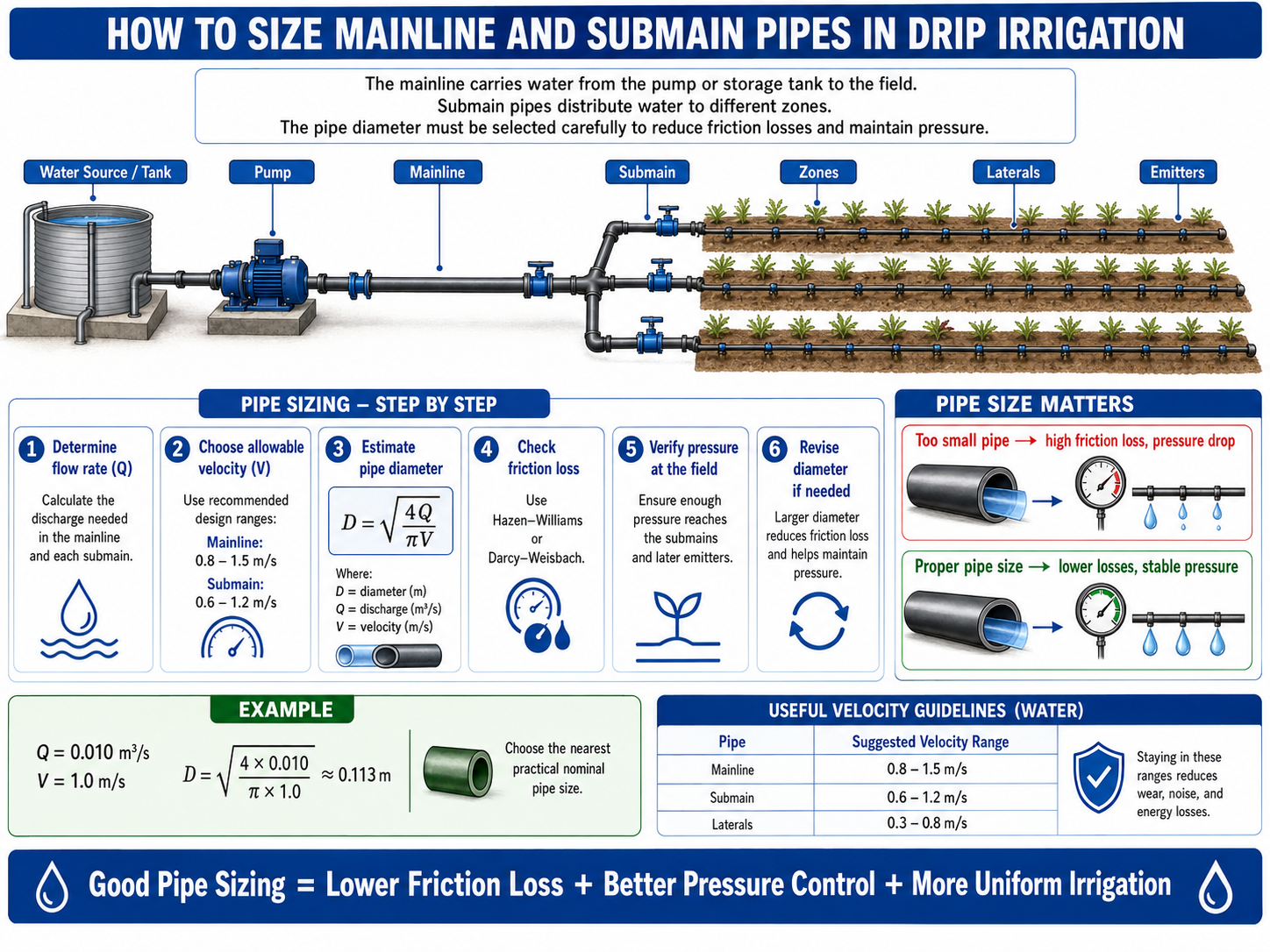
Comments
Comments are reviewed by AquaLinked Media before public display. If your email matches an approved AquaLinked expert profile, your comment may appear with your expert profile link after approval.
No approved comments yet. Be the first to contribute respectfully.
No password is needed. Enter the email connected to your expert profile, and the system will check whether your expert profile exists.
Please login or register before commenting.