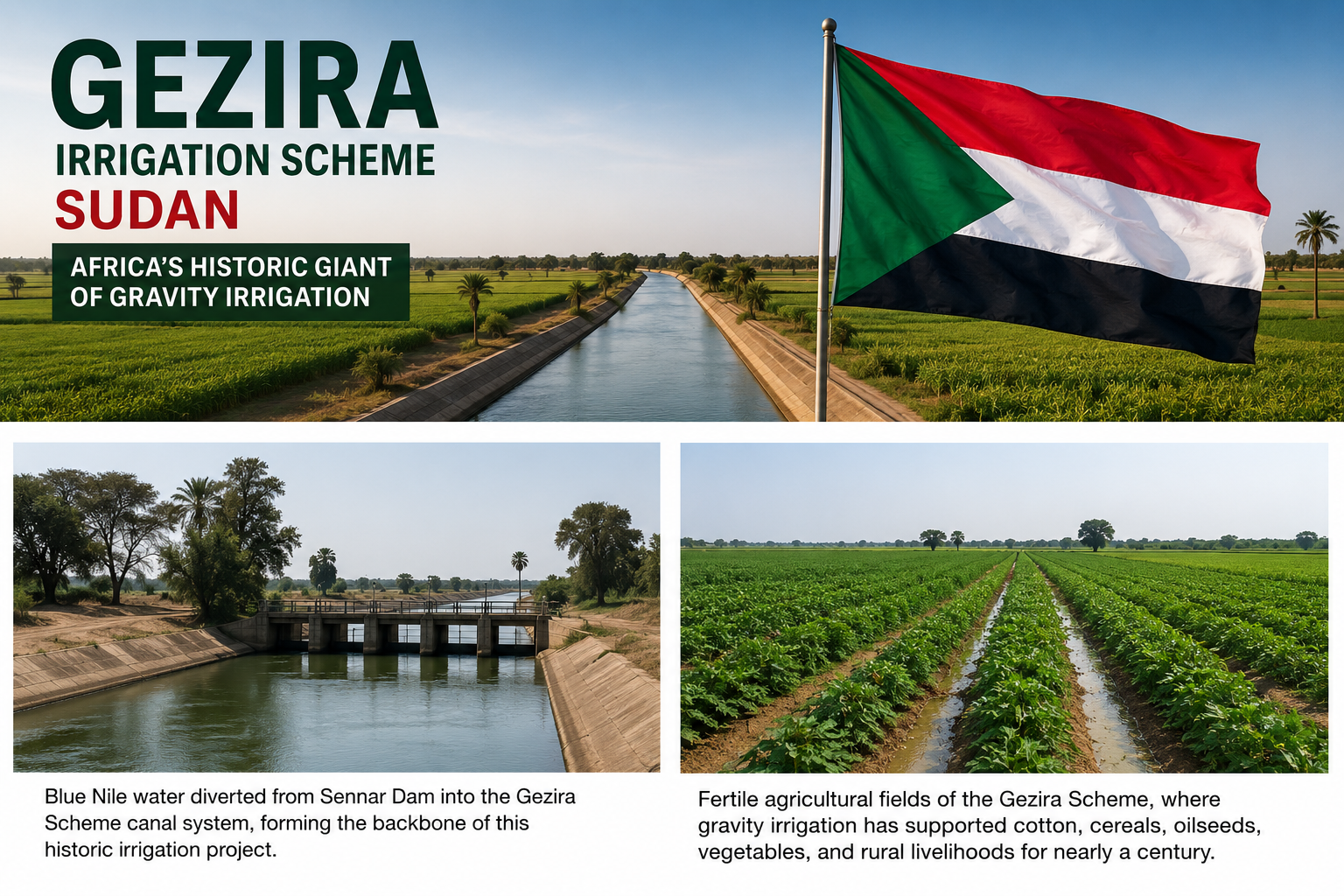
Gezira Irrigation Scheme: Sudan’s Historic Giant of Gravity Irrigation
The Gezira Irrigation Scheme in Sudan is one of the most important irrigation achievements in African agricultural history. Located between the Blue Nile and the White Nile, south of Khartoum, the scheme is not only a farming project. It is a major water-management system, a national agricultural platform, and one of the clearest examples of how river regulation, gravity irrigation, canal networks, and large-scale farming can transform a region.
The scheme began in 1925 after the construction of Sennar Dam on the Blue Nile. From the beginning, its purpose was to use controlled Blue Nile water to irrigate the fertile Gezira plain. It initially covered about 300,000 feddans, a traditional Sudanese and Egyptian land unit equivalent to roughly 126,000 hectares. Through later expansion, including major extensions to the irrigation network, the scheme grew to about 2.1 million feddans, equivalent to roughly 882,000 hectares. This makes Gezira one of the largest gravity-fed irrigation schemes in the world.
The project is historically important because it shows that Africa’s experience with large-scale irrigation did not begin recently. Sudan developed one of the continent’s most ambitious irrigation systems nearly a century ago. The scheme supported cotton production, food crops, rural livelihoods, national revenue, and agricultural industries. It also became a major case study in irrigation management, canal operation, farmer organization, land use, water governance, and long-term infrastructure maintenance.
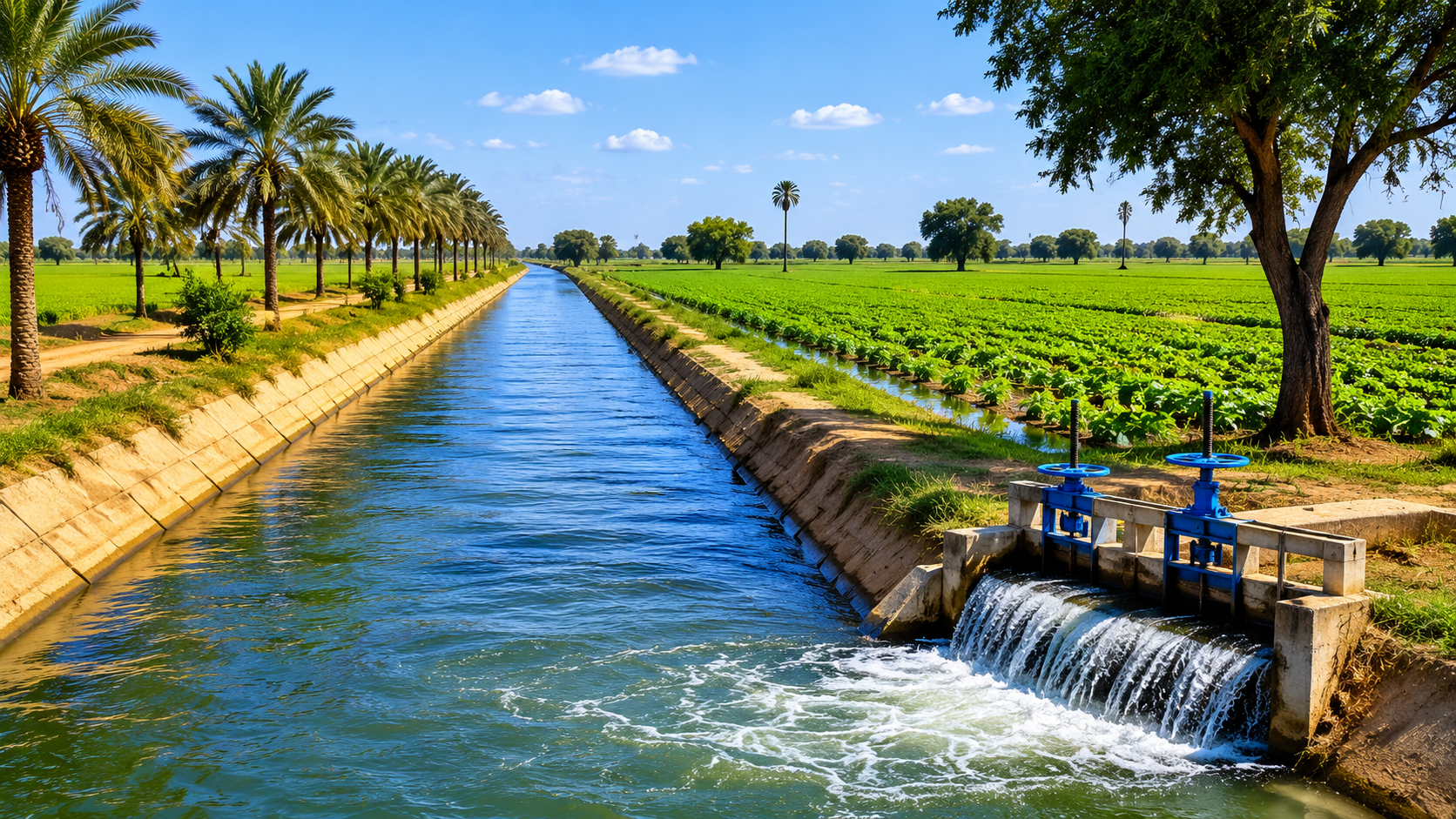
A wide view of Gezira’s canal system would show the heart of the project: Blue Nile water diverted by Sennar Dam, carried through main canals, branch canals, minor canals, and field channels, then delivered to agricultural fields by gravity. This is very different from modern sprinkler or drip irrigation. Gezira is mainly a surface irrigation system based on gravity-fed canal distribution, with traditional field irrigation methods such as basin and furrow irrigation.
Project Fact Box
- Project: Gezira Irrigation Scheme
- Country: Sudan
- Location: Gezira plain, between the Blue Nile and the White Nile, south of Khartoum
- Main water source: Blue Nile
- Main dam / diversion structure: Sennar Dam
- Dam completed: 1925
- Main purpose: Large-scale irrigation and agricultural production
- Irrigation type: Gravity-fed surface irrigation
- Field irrigation method: Mainly canal-fed basin and furrow irrigation, not a sprinkler or drip-irrigation scheme
- Original irrigated area: About 300,000 feddans
- Expanded irrigated area: About 2.1 million feddans
- Equivalent area: About 882,000 hectares
- Main crops: Cotton, wheat, sorghum, groundnuts, vegetables, and other field crops
- Sennar Dam reservoir storage: About 930 million cubic metres at initial storage capacity
- Water use note: The scheme uses Blue Nile water diverted and regulated through Sennar Dam and associated canal headworks
Project cost note: A single reliable original total cost for the 1925 Gezira Scheme is not consistently stated in the available technical sources. Later related Blue Nile irrigation and storage works, including the Roseires project and extensions/intensification connected to Gezira/Managil, were reported in World Bank sources with separate estimated costs, but these should not be confused with the original Gezira project cost.
Strategic value: Irrigation, food security, cotton production, rural livelihoods, agricultural modernization, and African water-infrastructure history
A Historic Irrigation Project Built Around Sennar Dam
The Gezira Scheme depends on the Blue Nile and on the Sennar Dam system. Sennar Dam was built on the Blue Nile to store and divert water for irrigation. Its role is central because the Gezira plain has a gentle natural slope that allows water to flow through canals by gravity. This means that the main water-distribution system does not depend primarily on large-scale pumping.
This gravity advantage is one of the most important engineering features of the project. Water enters the irrigation system from headworks on the left bank of the Blue Nile and then moves through a hierarchy of canals. The main canal carries water into the scheme, branch canals distribute it to larger command areas, minor canals carry it closer to farms, and field channels deliver it to cultivated land.
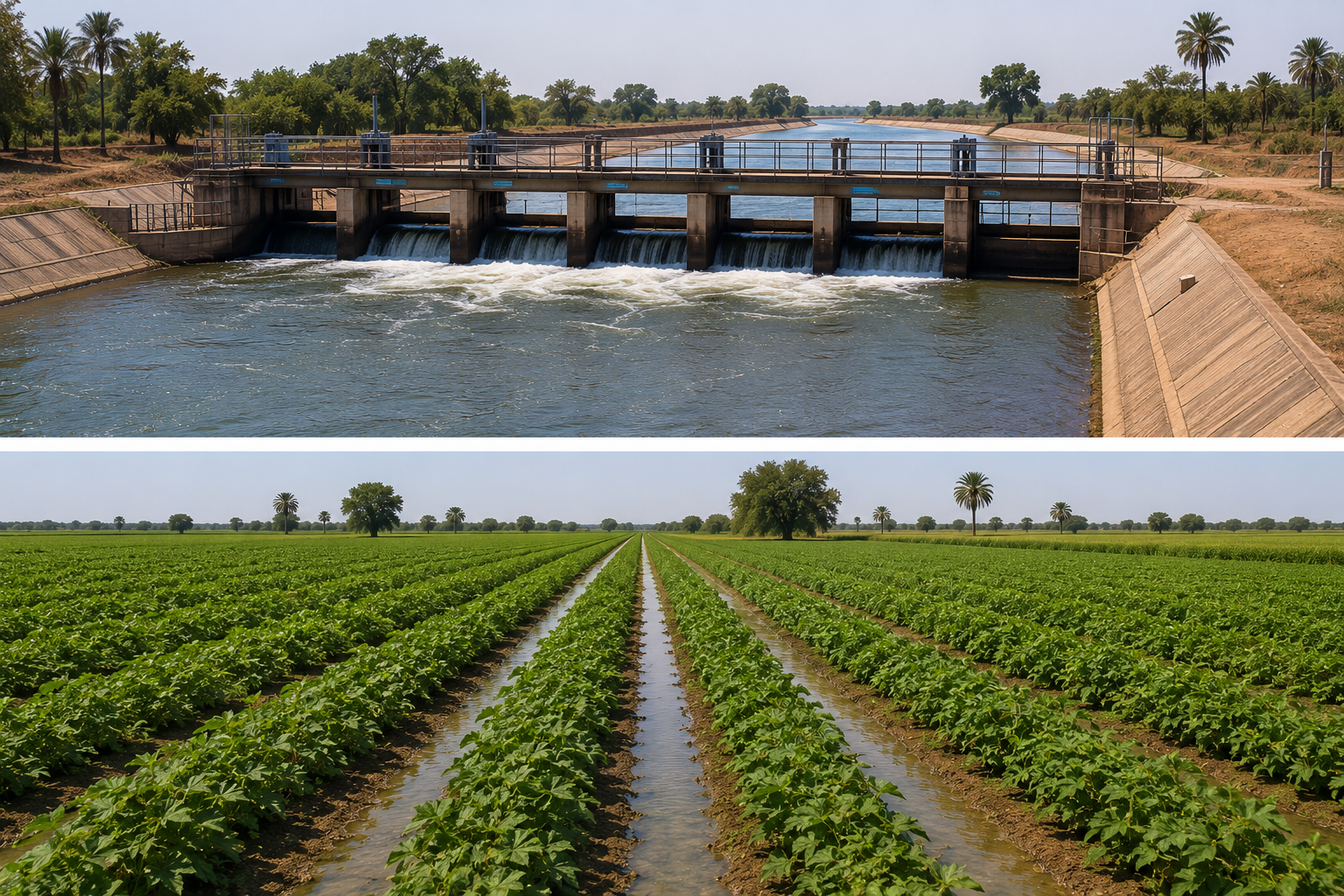
Because of this design, the Gezira Scheme became a classic example of large-scale surface irrigation. It is not a sprinkler-irrigation project and it is not a drip-irrigation project. It is mainly a gravity-fed canal irrigation system where water is applied to fields through surface methods. In many areas, traditional basin irrigation and furrow irrigation have been used, depending on crop type, field layout, water availability, and management practice.
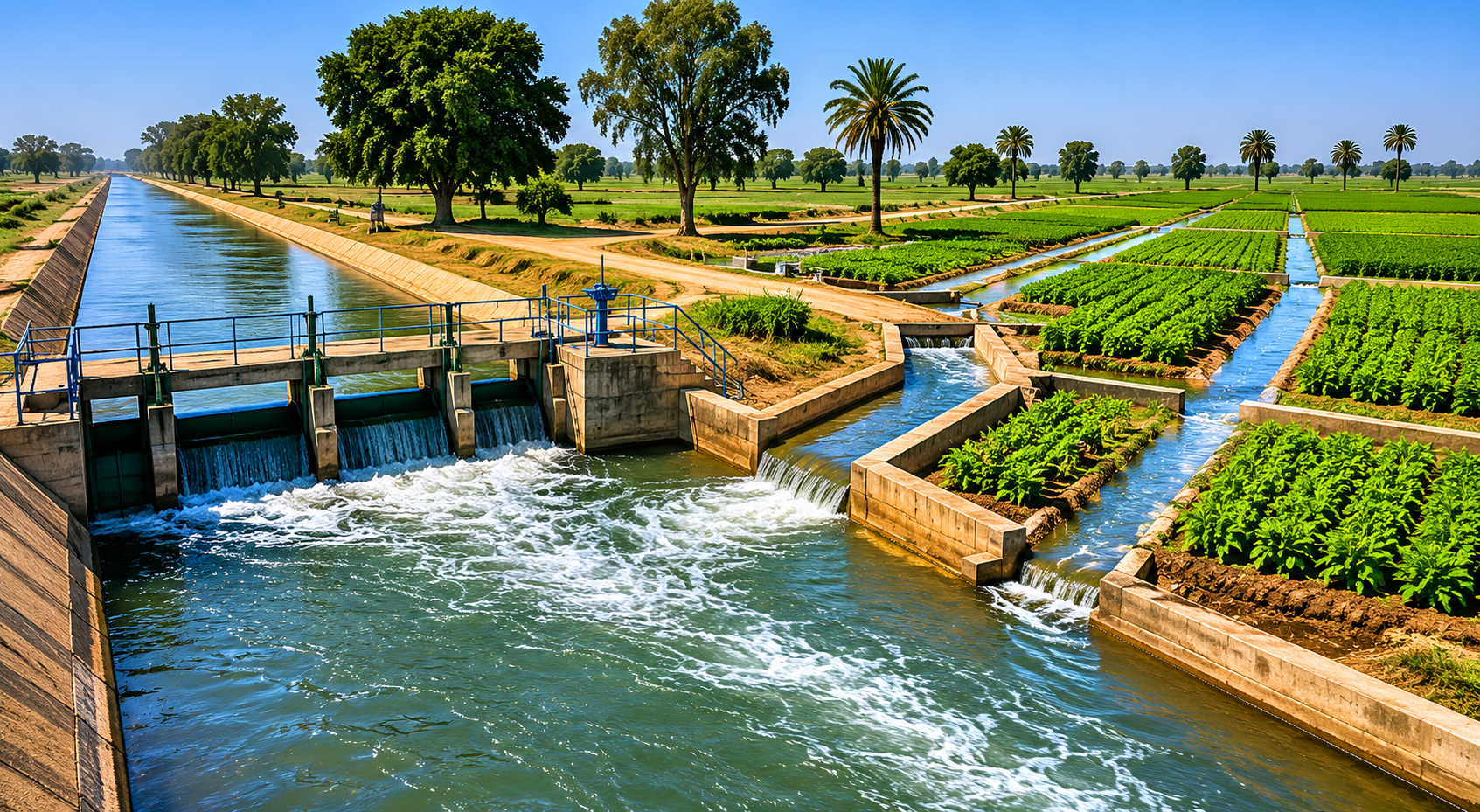
Salient Points of the Project
The first salient point is scale. The Gezira Scheme expanded to about 2.1 million feddans, or approximately 882,000 hectares. This makes it one of the largest irrigation systems in Africa and one of the largest gravity-fed irrigation schemes under a single management tradition.
The second salient point is its water source. The project depends on the Blue Nile, one of the most important tributaries of the Nile system. The Blue Nile has strong seasonal variation, with high flows during the rainy season and much lower flows during the dry period. This makes storage, diversion, canal regulation, and water scheduling essential.
The third salient point is the role of Sennar Dam. The dam was completed in 1925 and was built specifically to support large-scale irrigation. Its reservoir and headworks allowed Blue Nile water to be controlled and diverted into the Gezira canal system. Without Sennar Dam, the Gezira Scheme could not function at its historic scale.
The fourth salient point is the irrigation method. Gezira is mainly a gravity-fed surface-irrigation scheme. Its power lies in canal hydraulics, land slope, water control structures, canal maintenance, and field-level water management. This makes it a valuable learning case for engineers, hydrologists, irrigation planners, and agricultural-water managers.
The fifth salient point is agricultural importance. The scheme became strongly associated with cotton production, but it also supported food crops such as wheat, sorghum, groundnuts, vegetables, and other crops. In this way, it contributed to both export agriculture and food security.
The sixth salient point is governance. Gezira is not only a physical canal system. It is also an institutional system involving government agencies, irrigation authorities, farmers, water-user groups, crop planning, canal operation, field maintenance, land administration, and agricultural services. Its performance depends as much on governance as on engineering.
The seventh salient point is rehabilitation. A scheme of this size cannot survive by construction alone. It requires continuous canal desilting, gate maintenance, drainage improvement, field-channel cleaning, water scheduling, farmer participation, and modernization of management systems. The history of Gezira shows that even great infrastructure can decline if operation and maintenance are neglected.
Engineering and Water-Management Ability
The engineering ability of the Gezira Scheme is based on the controlled movement of water over a large command area. The scheme takes advantage of the natural slope of the Gezira plain. This allows water to move from the main canal system toward the fields with limited need for pumping.
The system includes main canals, branch canals, minor canals, regulators, field outlets, and drainage channels. The success of such a system depends on correct water levels, proper gate operation, fair distribution between head and tail areas, and regular removal of silt and weeds from canals.
The Blue Nile carries a high sediment load during flood periods. This creates a constant maintenance challenge. Sediment can reduce canal capacity, disturb water delivery, block outlets, and create inequality between farmers near the head of canals and those near the tail. Therefore, sediment management and canal maintenance are not small technical details; they are central to the survival of the project.
Irrigation Area and Agricultural Command
The Gezira Scheme’s expanded command area of about 2.1 million feddans, or about 882,000 hectares, makes it a continental-scale irrigation system. This is not a small local project. It is a regional agricultural landscape shaped by water control.
The project originally began with a much smaller area, about 300,000 feddans, before later expansion. The Managil extension increased the command area and helped the scheme reach its larger modern scale. This long expansion history shows how one dam and one canal system became the foundation for a much larger irrigation economy.
The irrigation area supports a mixture of cash crops and food crops. Cotton was historically the dominant commercial crop, especially during the earlier decades of the scheme. Later, food crops became increasingly important as Sudan’s agricultural and economic priorities changed.
Project Cost and Investment Note
The original total cost of the Gezira Scheme is difficult to present as one modern figure because the project was built and expanded in stages over a long historical period. The core system began around Sennar Dam in 1925, then later extensions and rehabilitation works were added.
For this reason, it is more accurate to say that the original project cost is not consistently documented as one complete figure in the available public technical sources. However, related Blue Nile storage and irrigation investments were later costed separately. For example, World Bank records for the Roseires Irrigation Project reported an estimated cost of about US$87.8 million for dam construction and about US$88.7 million for new irrigation schemes and the extension and intensification of Gezira/Managil gravity irrigation schemes. These figures belong to later related works and should not be presented as the original cost of the Gezira Scheme itself.
This cost note is important because it avoids a common mistake: mixing the original Gezira project, Sennar Dam, the Managil extension, Roseires Dam, and later rehabilitation works into one unclear number. Gezira should be understood as a historic irrigation system built in phases, not as a single modern contract with one simple project-cost figure.
Economic and Agricultural Importance
For many decades, Gezira was one of the pillars of Sudan’s agricultural economy. Cotton production from the scheme generated export earnings and supported national revenue. The project also created livelihoods for farmers, workers, transporters, traders, input suppliers, and agro-industrial activities.
The scheme’s contribution goes beyond economics. It helped shape settlements, agricultural communities, water-management institutions, and Sudan’s national identity as an irrigated agricultural country. It also provided experience in managing large command areas, crop rotations, canal delivery, farmer relations, and irrigation administration.
Gezira’s food-security role is also important. In a country affected by rainfall variability, drought risk, conflict, and economic instability, irrigated agriculture can provide a more stable production base than rain-fed farming alone. This makes the scheme a strategic national asset, even when it faces operational problems.
Current Challenges and Rehabilitation Needs
The Gezira Scheme has faced many challenges over time. These include aging infrastructure, canal siltation, weak maintenance, inefficient water distribution, drainage problems, declining productivity, institutional changes, and farmer-management difficulties.
The most important lesson is that a large irrigation system requires continuous care. Canals must be cleaned. Regulators must work. Drainage must function. Farmers must receive water at the right time. Field channels must be maintained. Crops must be planned according to water availability. Institutions must be strong and transparent.
Modernization does not necessarily mean replacing the whole scheme with sprinkler or drip irrigation. In a system like Gezira, modernization may begin with better canal operation, improved water measurement, digital crop monitoring, remote sensing, gate rehabilitation, drainage improvement, sediment management, and stronger farmer participation.
Why Gezira Is Important
The Gezira Irrigation Scheme is important because it is one of Africa’s great irrigation schools. It teaches engineers and planners how large gravity systems work. It teaches policymakers that water infrastructure must be supported by institutions. It teaches farmers and managers that irrigation is not only water delivery but also timing, maintenance, fairness, crop planning, and governance.
The scheme also shows the power and risk of large-scale irrigation. When well managed, it can support national production, food security, exports, rural livelihoods, and agricultural industries. When neglected, it can suffer from low productivity, poor water distribution, silted canals, weak maintenance, and social frustration.
For AquaLinked / Water for Africa Experts Media, the Gezira Irrigation Scheme deserves a central place in the series “Major Irrigation Projects in Africa.” It is historic, technically important, agriculturally powerful, and full of lessons for the future of African irrigation.
Gezira is not only a Sudanese project. It is an African water heritage project. It shows that the continent has long experience in managing rivers, dams, canals, agriculture, and rural transformation. Its future depends on rehabilitation, wise governance, farmer empowerment, and renewed investment in irrigation excellence.
Sources
Official references used for this article.
Comments
Comments are reviewed by AquaLinked Media before public display. If your email matches an approved AquaLinked expert profile, your comment may appear with your expert profile link after approval.
No approved comments yet. Be the first to contribute respectfully.
No password is needed. Enter the email connected to your expert profile, and the system will check whether your expert profile exists.
Please login or register before commenting.