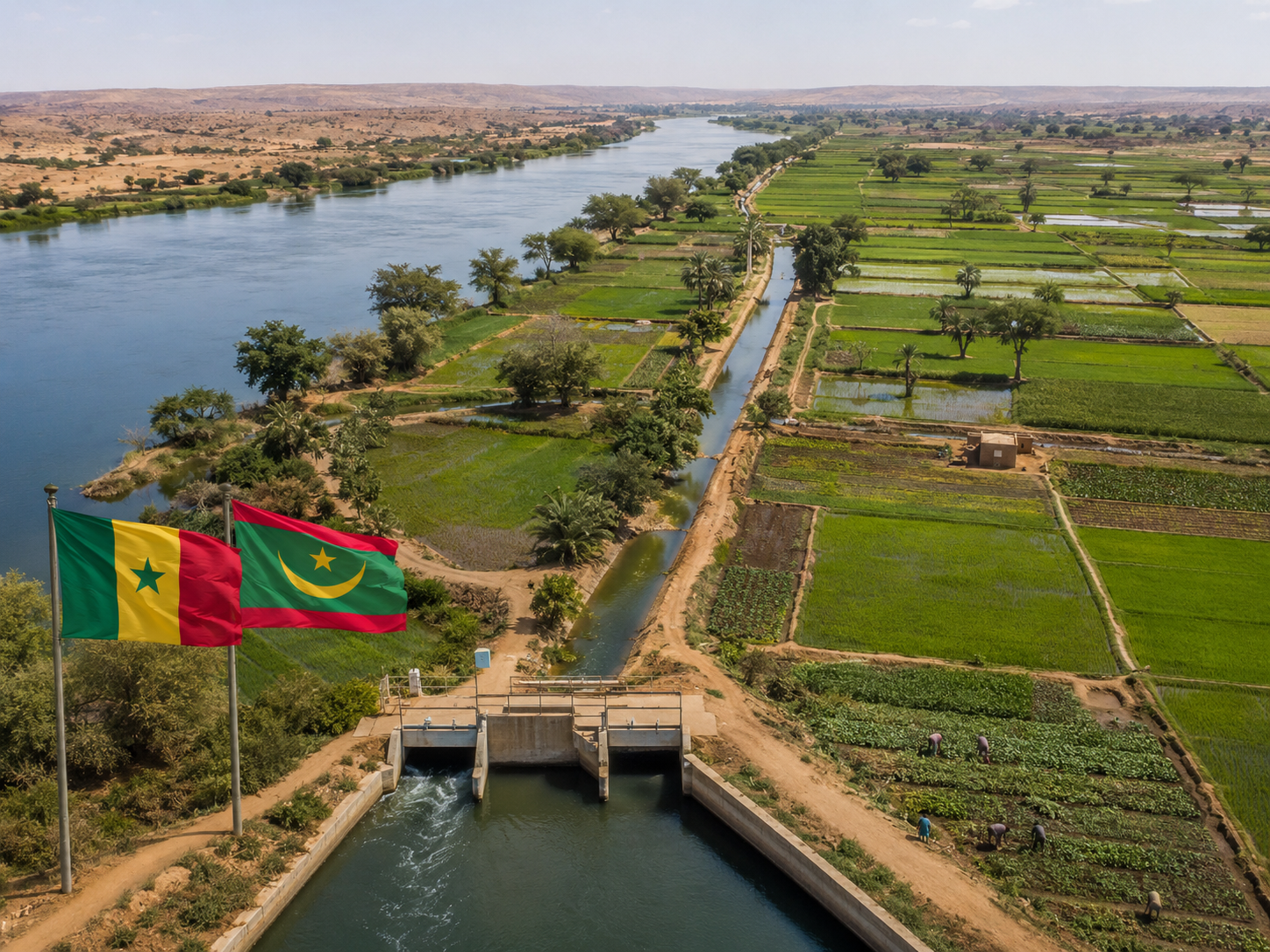
Senegal River Valley Irrigation Schemes — Senegal / Mauritania
The Senegal River Valley Irrigation Schemes are among the most important irrigation-development systems in West Africa. The Senegal River forms a natural boundary between Senegal and Mauritania for much of its lower course, while also connecting Mali and Guinea upstream through the wider Senegal River Basin. Along both banks of the river, irrigation schemes have been developed to support rice production, vegetables, livestock-feed crops, rural livelihoods, and national food-security strategies.
The valley has long supported traditional farming, fishing, grazing, and flood-recession agriculture. For centuries, communities depended on the natural rise and fall of the river to cultivate crops after floodwaters receded. However, droughts, population growth, food-import dependence, and climate variability pushed Senegal and Mauritania to invest more heavily in controlled irrigation. Today, the Senegal River Valley is one of the region’s most important examples of river-based agricultural transformation.
Project Fact Box
- Project name: Senegal River Valley Irrigation Schemes
- Countries: Senegal and Mauritania
- Main basin: Senegal River Basin
- Main river: Senegal River
- Main development corridor: Lower and middle Senegal River Valley, including delta and valley irrigation areas
- Main institutions: OMVS, SAED in Senegal, and SONADER in Mauritania
- Project type: Transboundary river irrigation, rice production, village irrigation, large-scale irrigation, drainage, floodplain management, and agricultural modernization
- Main crops: Rice, vegetables, onions, tomatoes, maize, sorghum, fodder crops, and other food crops
- Main purpose: Food security, rice self-sufficiency, rural employment, climate resilience, agricultural modernization, and regional development
- Strategic importance: One of West Africa’s most important irrigated agricultural corridors shared by two countries along an international river
- Why the Senegal River Valley Is Important
The Senegal River Valley is important because it brings together water, land, agriculture, and regional cooperation. Unlike purely national irrigation projects, this system depends on a shared river. Senegal and Mauritania both rely on the same river corridor for irrigation, food production, pastoral activities, fishing, domestic water supply, and local economies.
The creation of the Organisation pour la Mise en Valeur du fleuve Sénégal, known as OMVS, gave the basin a cooperative institutional framework. Through OMVS, member states have worked to manage the river for irrigation, hydropower, navigation, flood control, and broader economic development. This makes the Senegal River Valley a major example of how African countries can manage shared water resources through regional institutions instead of conflict.
The irrigation schemes are also important because rice is a strategic food crop in both Senegal and Mauritania. Senegal especially imports large quantities of rice, making domestic irrigated rice production a national priority. The valley therefore plays a key role in food-sovereignty planning and in reducing vulnerability to international food-price shocks.
Irrigation Development on the Senegalese Side
On the Senegalese side, irrigation development is strongly associated with SAED, the national agency responsible for the development and exploitation of the Senegal River Delta, the Senegal River Valley, and the Falémé Valley. SAED has supported large irrigation schemes, medium-scale schemes, village irrigation schemes, private irrigation schemes, rehabilitation works, drainage infrastructure, farmer support, and rice-production development.
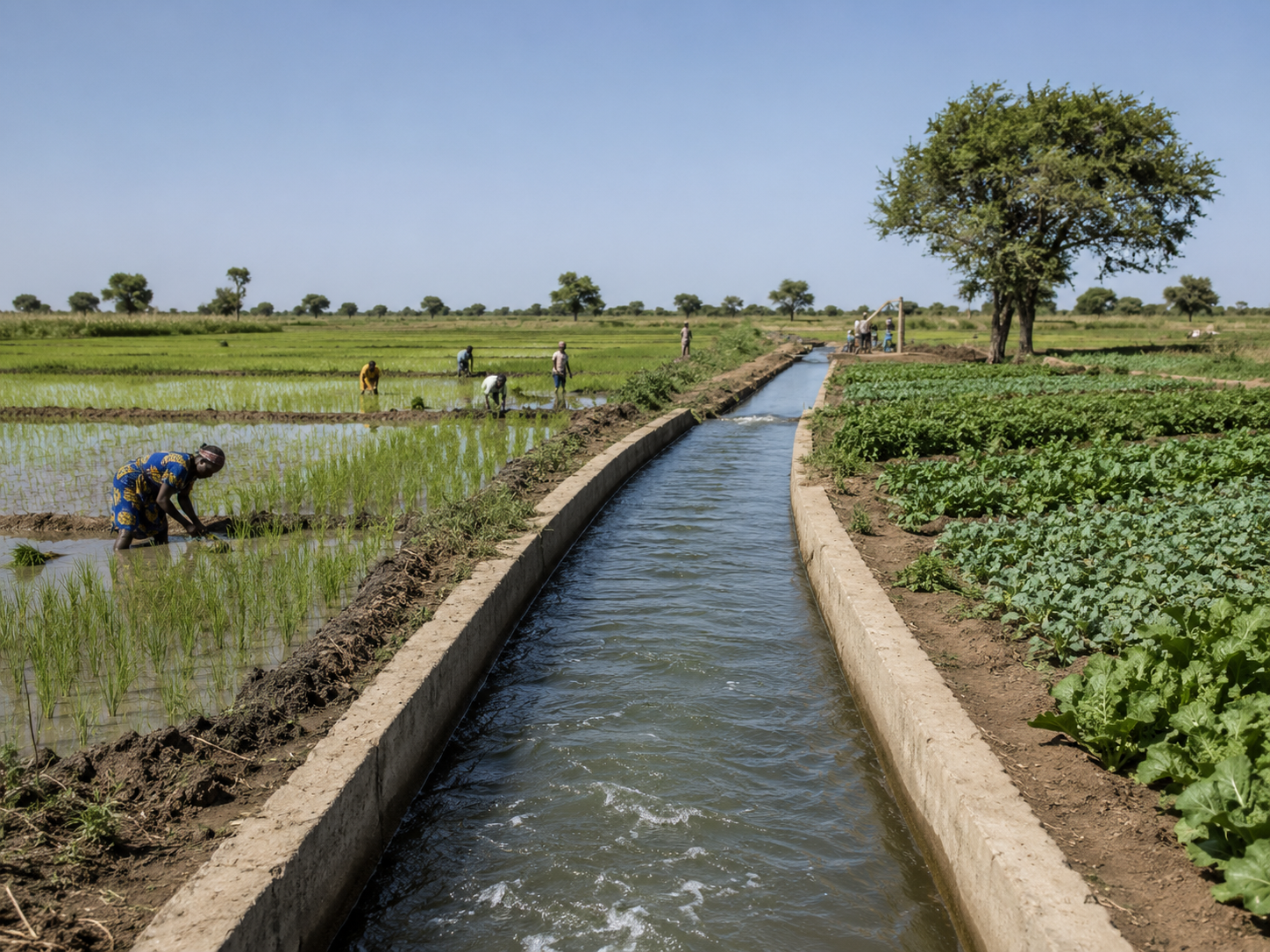
Irrigation schemes in the Senegal River Valley have been classified into several categories, including large-scale public irrigation schemes, village irrigation schemes, and private irrigation schemes. Village irrigation schemes are often smaller systems developed for farmer groups, while larger schemes may involve more formal infrastructure, canals, drainage systems, pumping stations, and organized management.
The Senegalese valley includes important irrigation areas around the delta, Dagana, Podor, Matam, and Bakel zones. These areas support rice production, onion production, vegetable cultivation, and other agricultural activities. In many places, irrigation has changed the seasonal rhythm of farming by allowing controlled water supply instead of complete dependence on rainfall or natural floods.
Irrigation Development on the Mauritanian Side
On the Mauritanian side, irrigation development is closely linked with SONADER, the Société Nationale de Développement Rural. SONADER has played a central role in hydro-agricultural development along Mauritania’s side of the Senegal River Valley. The Mauritanian valley is one of the country’s most important agricultural regions because much of Mauritania is arid or semi-arid, making reliable irrigated agriculture especially valuable.
Mauritania’s irrigation schemes support rice production, vegetables, livestock-feed crops, and rural livelihoods. The river valley is also strategically important because it provides one of the country’s best opportunities for intensifying agriculture under controlled water conditions. Recent planning efforts have focused on updating master plans for hydro-agricultural development and strengthening climate-resilient agricultural investment in the valley.
The Mauritanian side also contains village irrigation schemes and larger public or private developments. These projects must address water delivery, drainage, soil salinity, land tenure, maintenance, farmer organization, and market access. In an arid country, the Senegal River Valley is therefore not just an agricultural zone; it is a national food-security asset.
Engineering and Water-Management Significance
From an engineering perspective, the Senegal River Valley irrigation systems are significant because they depend on river regulation, canals, pumping stations, drainage networks, field layouts, floodplain protection, and coordinated water allocation. The development of dams and river regulation has made it possible to provide more reliable water for irrigation, especially during dry periods.
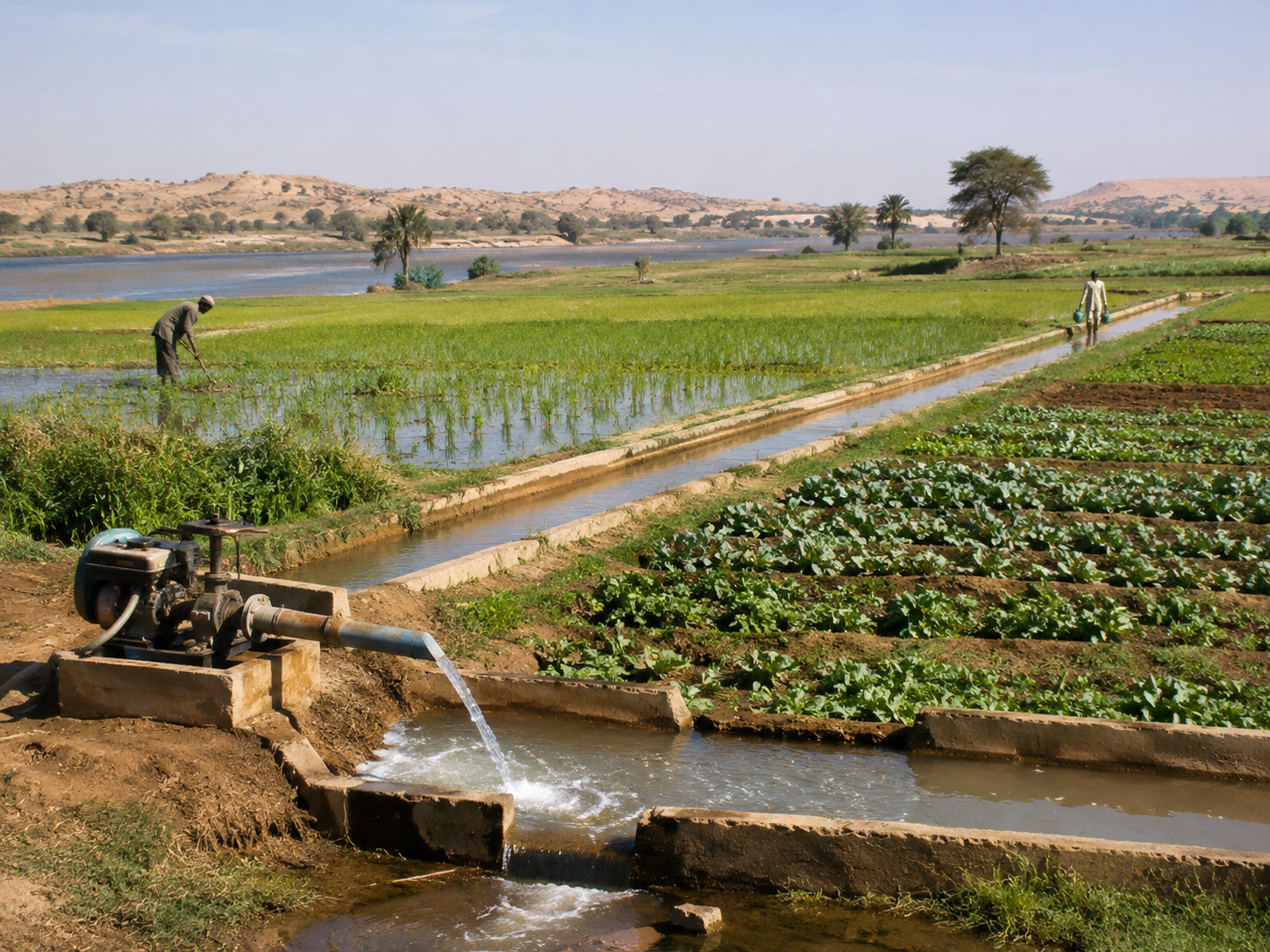
However, irrigation in a river valley is technically demanding. Water must be diverted or pumped from the river, conveyed through canals, distributed to fields, and then drained properly to avoid waterlogging and salinity. Drainage is especially important in rice-growing areas because poor drainage can damage soils and reduce productivity. Some schemes have required specific drainage improvements to remove excess water in an environmentally acceptable way.
The valley also shows the importance of maintenance. Irrigation canals, pumps, gates, drains, roads, and field channels must be maintained continuously. Without maintenance, even well-designed schemes can lose efficiency. Sedimentation, weed growth, pump failure, and poor water control can reduce the productivity of irrigated agriculture.
Agricultural and Food-Security Importance
The Senegal River Valley is one of the main rice-production zones for both Senegal and Mauritania. Rice is central to food security in the region, and irrigated rice allows farmers to produce under more controlled conditions than rain-fed agriculture. Irrigation also supports vegetable crops such as onions and tomatoes, which are important for local markets, household income, and national supply.
The valley also helps reduce climate risk. In the Sahel, rainfall can be uncertain and droughts can be severe. Irrigation gives farmers a more reliable production base, allowing dry-season cropping and sometimes double cropping where water, land, labour, and market conditions allow it.
At the same time, irrigation does not automatically guarantee food security. Productivity depends on seed quality, fertilizer use, water timing, mechanization, credit, farmer training, storage, processing, and market access. The Senegal River Valley therefore shows that irrigation infrastructure must be connected to the entire agricultural value chain.
Challenges and Lessons
The Senegal River Valley irrigation schemes have achieved important progress, but they also face serious challenges. These include high operation and maintenance costs, pump reliability, canal maintenance, drainage problems, soil salinity, land-tenure disputes, unequal access to developed land, farmer-organization challenges, and market difficulties.
Environmental challenges are also important. River regulation and irrigation can alter natural flood patterns, affect fisheries, change wetland ecosystems, and reduce traditional flood-recession agriculture and grazing areas. In some areas, poorly drained irrigation can contribute to soil salinization or waterlogging. This means irrigation expansion must be accompanied by strong environmental monitoring and good drainage design.
Climate change adds another layer of complexity. The valley faces both drought and flood risks. Recent flood events in the region have shown that farmers can lose crops when water levels rise unexpectedly. This demonstrates that irrigation planning must include not only water supply, but also flood protection, drainage, early warning, and climate-resilient land-use planning.
Transboundary Cooperation and OMVS
One of the most important lessons from the Senegal River Valley is the value of transboundary cooperation. The river is shared, and irrigation development on one side can affect water availability, river flows, ecosystems, and livelihoods elsewhere. OMVS provides a framework through which Senegal, Mauritania, Mali, and Guinea can coordinate development of the basin.
This cooperative approach is highly important for Africa. Many African rivers cross national borders. If countries work separately, water development can create tension. If they work through strong institutions, shared rivers can become sources of cooperation, energy, food production, navigation, and regional integration.
The Senegal River Valley therefore teaches that irrigation is not only a national engineering matter. It is also diplomacy, governance, and shared responsibility.
Why These Schemes Matter for Africa
The Senegal River Valley Irrigation Schemes matter because they show how irrigation can transform a river corridor across national borders. They demonstrate the power of shared water management, rice production, farmer settlement, village irrigation, public investment, and regional cooperation.
For Senegal and Mauritania, the schemes support food security, rural employment, income generation, and agricultural modernization. For Africa, they provide an important lesson: irrigation development must be planned as a complete system involving water control, drainage, soil protection, farmer support, river-basin cooperation, environmental safeguards, and market access.
The Senegal River Valley is not only a collection of canals and fields. It is a living transboundary landscape where water, people, agriculture, ecology, and regional cooperation meet. Its future success will depend on maintaining that balance with intelligence, fairness, and long-term vision.
Sources
Official references used for this article.
Comments
Comments are reviewed by AquaLinked Media before public display. If your email matches an approved AquaLinked expert profile, your comment may appear with your expert profile link after approval.
No approved comments yet. Be the first to contribute respectfully.
No password is needed. Enter the email connected to your expert profile, and the system will check whether your expert profile exists.
Please login or register before commenting.