AquaLinked Store Bookstore & Water Technology Shop

Soil Moisture Sensor for Drip Irrigation System

View the book, technical guide, training material, or water technology item in detail.
Soil Moisture Sensor for Drip Irrigation System

Move the mouse over the product image. A zoom preview will appear beside the product. Click the image to open it full size.

water-technology

Soil Moisture Sensor for Drip Irrigation System

Category: Drip Irrigation Components

Price on request

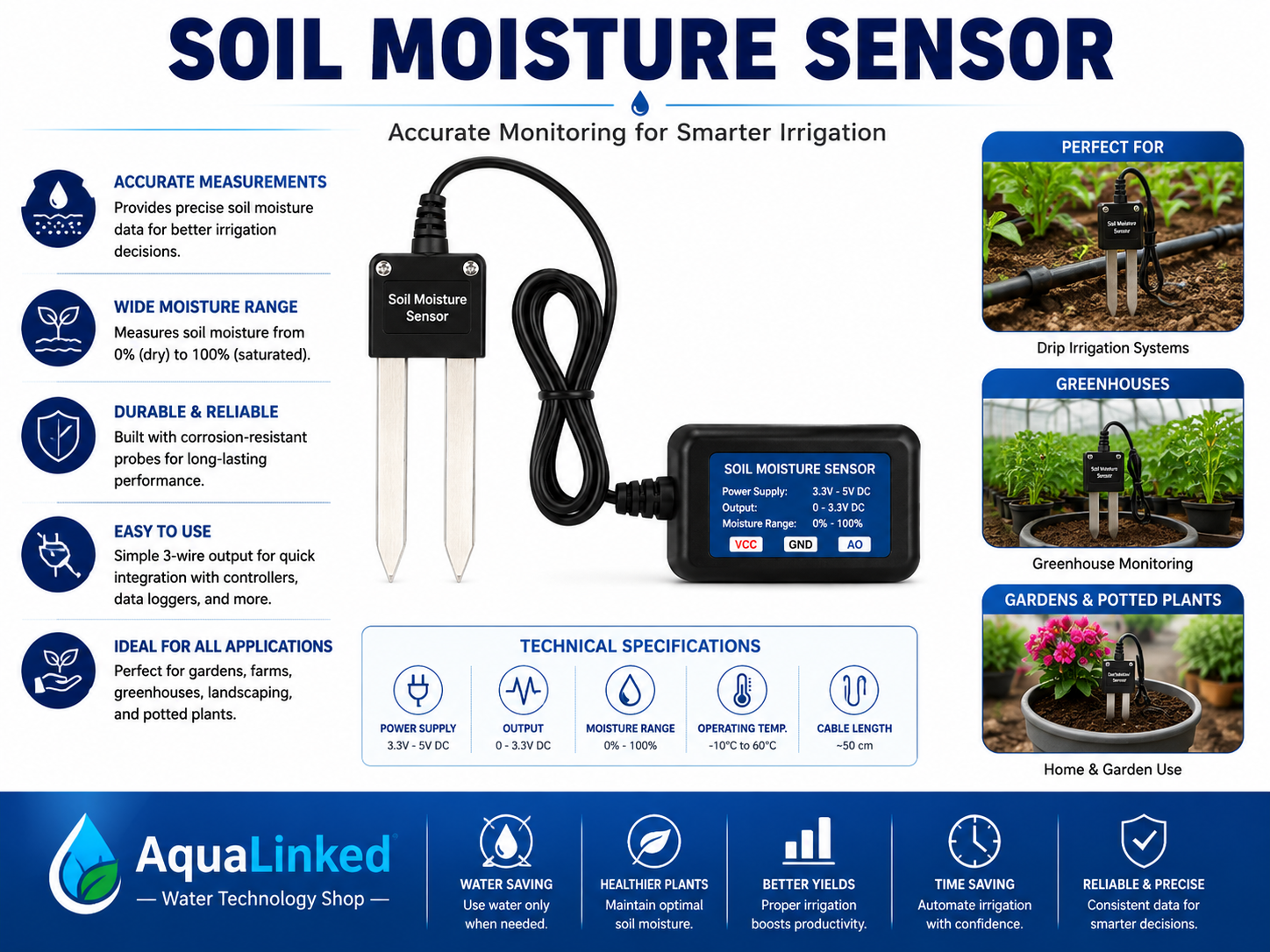
A soil moisture sensor measures the water condition in the crop root zone and helps decide when irrigation is needed. It supports smart drip irrigation, prevents over-watering and under-watering, saves water, improves crop health, and can be connected to controllers, timers, solenoid valves, or smart irrigation systems.

Coming soon This material is currently not in stock. Please visit us again later, or send an inquiry if you would like to be notified when it becomes available.

Product Description

A soil moisture sensor is a smart irrigation device used to measure the amount of water available in the soil around the plant root zone. It helps farmers, gardeners, greenhouse operators, and irrigation technicians understand whether the soil is dry, moist, or sufficiently wet before irrigation is applied.

In a drip irrigation system, the sensor is placed in the soil near the crop root zone. It detects soil moisture and sends a signal to a controller, data logger, or smart irrigation system. When the soil becomes too dry, the system can start irrigation. When enough moisture is available, irrigation can be delayed or stopped. This helps avoid both over-irrigation and under-irrigation.

The soil moisture sensor is very useful in drip irrigation because drip systems apply water directly near the roots. By measuring moisture close to the roots, the sensor helps determine when the crop actually needs water. This improves irrigation timing, saves water, reduces unnecessary pumping, protects the crop from water stress, and supports better yield.

Availability, Delivery and Support

Stock Status coming_soon

For special delivery, bulk purchase, technical support, or supplier confirmation, visitors can send an inquiry before purchase.

Ask About Availability

Customer Reviews

Customer Reviews

Reviews are published after admin approval.
0.0 / 5
☆☆☆☆☆
0 approved reviews
Direct link

Technical Material Information

Manufacturer / Producer
Produced by irrigation automation, smart-farming, sensor, and water-management equipment manufacturers.
Manufacturer Note
Moisture Range:
Common sensors may measure from dry soil to saturated soil, often represented as 0%–100% moisture range depending on calibration and sensor type.

Best Used With:
Drip irrigation system, irrigation controller, timer, solenoid valve, data logger, moisture-based irrigation automation, greenhouse monitoring system, and smart farming platform.

Practical Installation Note:
Install the sensor where plant roots are active and where drip irrigation water reaches the soil. Avoid air gaps around the probes. The soil should be pressed gently around the sensor after installation. Do not place the sensor directly under a dripper unless the goal is to measure the wettest point. For good irrigation decisions, place sensors in representative soil locations.
Material
Engineering plastic or ABS sensor body, stainless-steel or corrosion-resistant metal probes, insulated signal cable, waterproof or water-resistant housing depending on model, and electronic sensing components inside the sensor body.
Pipe / Tape Diameter
Sensor size varies by model. Common probe lengths may range from about 5 cm to 15 cm or more. Cable length may range from 50 cm to several meters depending on the system requirement.
Connection Type
Usually connected by signal cable to an irrigation controller, data logger, PLC, microcontroller, or smart irrigation unit. Some models use analog output, digital output, RS485, SDI-12, Wi-Fi, or IoT communication depending on model.
Working Pressure
Common models may use 3.3V–5V DC, 12V DC, or 24V DC depending on the sensor and controller system.
Application
Main Use:
Used for soil-water monitoring, irrigation scheduling, automatic irrigation control, greenhouse monitoring, smart farming, gardens, nurseries, orchards, vegetable fields, and potted plants.

Key Benefits:

Measures soil moisture near the root zone
Helps prevent over-watering and under-watering
Saves water by irrigating only when needed
Supports better crop growth and healthier plants
Helps improve irrigation scheduling
Useful for automatic and smart irrigation systems
Reduces labor and guesswork in irrigation management
Can support better yield and water-use efficiency
Product Group / Sub-Group
Measurement and Monitoring
Bookstore Update

View Updates